Terrapod
A free, self-hosted replacement for Terraform Enterprise — runs your Terraform/OpenTofu plans and applies on your own Kubernetes cluster, with the access controls and audit trail a team needs, instead of paying HashiCorp for the privilege.
🔗 Visit Terrapod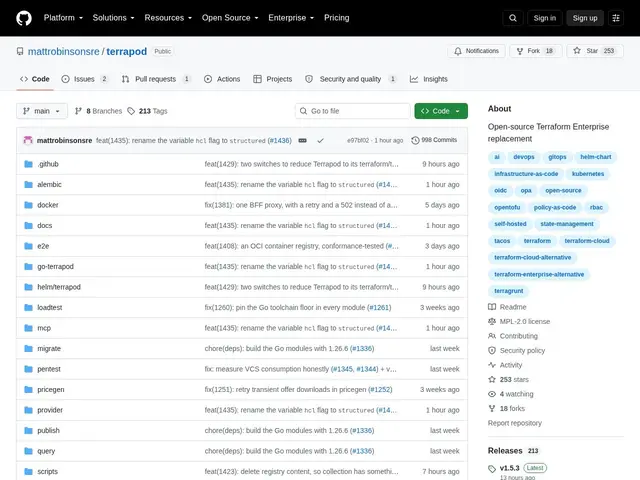
Description
Terraform itself is free, but running it safely as a team — with a shared state file, who's-allowed-to-apply-what rules, and a private place to store your own reusable modules — is normally where the paid tools come in (Terraform Cloud, Terraform Enterprise). Terrapod does that same job on infrastructure you already control: think of it as bringing the 'company edition' features in-house instead of renting them, run on your own Kubernetes cluster.
Terrapod is an open-source (MPL-2.0, the same license as OpenTofu) platform that implements a compatible subset of the Terraform Enterprise V2 API, so existing Terraform/OpenTofu workflows work with minimal changes. It provides versioned remote state with locking and rollback, label-based RBAC, OPA-based policy-as-code, a private module and provider registry with GPG signing, cost estimation, workload identity (no static cloud credentials to leak), and a web UI available in 27 languages. It deploys via Helm onto Kubernetes and runs jobs through outbound-only runners for network-restricted environments.
💬 Our review
The short version: Terrapod is a genuinely capable, feature-rich open-source stand-in for Terraform Enterprise — the real question isn't whether it does the job, it's whether a project with 253 GitHub stars and a small commit history is one you want holding your production infrastructure state.
On features it's competitive with the field: versioned state, RBAC, policy-as-code, a private registry, and workload identity cover most of what teams actually pay Terraform Enterprise or Scalr for, and API compatibility with TFE means you're not rewriting your CI. Compared to Terrakube (a similar-purpose, longer-running open-source project with roughly 4x the GitHub stars), Terrapod is the newer, less battle-tested option — which can mean faster iteration, or it can mean you hit bugs first.
The honest limits: this is early-stage infrastructure software, and infrastructure software is exactly the category where you don't want to be the one finding the edge cases. Before trusting it with real Terraform state, budget time for a proper eval — test the upgrade path, back up state independently, and read the issue tracker. If you want a more established open-source option with a larger community, Terrakube is worth comparing directly; if you'd rather not self-host any of this, Atlantis (free, CI-native, no separate server) or a paid platform like Terraform Cloud remain the lower-risk defaults.
💰 Pricing
📊 Global score
🤖 AI-enriched data
Open source (licence MPL-2.0), gratuit, auto-hébergé sur votre propre cluster Kubernetes.
Pros
Compatible avec l'API Terraform Enterprise V2 — peu de changement dans les workflows existants
State versionné avec verrouillage/rollback, RBAC, policy-as-code OPA, registry privé signé GPG
Workload identity — pas de credentials cloud statiques à protéger
Gratuit et open source, licence MPL-2.0 (même que OpenTofu)
Cons
Projet jeune et modeste (253 étoiles GitHub) comparé à Terrakube ou aux solutions payantes établies
Moins éprouvé en production à grande échelle — nécessite une évaluation prudente avant d'y confier du state critique
Nécessite un cluster Kubernetes pour l'auto-hébergement (pas de version SaaS)