Ontheia
A free, open-source, self-hosted AI agent platform built for organizations that can't send data to a third-party cloud — think law firms, clinics or banks — with role-based access, memory, and support for every major AI model.
🔗 Visit Ontheia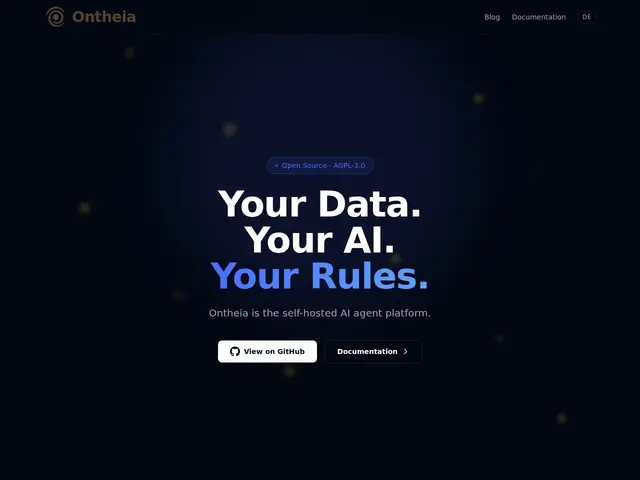
Description
Cloud AI assistants are convenient, but for a law firm, a clinic, or a bank, sending client data to a third-party's servers can be a compliance problem, not just a preference. Ontheia is built for exactly that situation: it's an AI agent platform you install and run entirely on your own servers, so every conversation, document and piece of data stays inside your own walls — a private office for your AI instead of a rented desk in someone else's building.
Ontheia is an open-source (AGPL-3.0) platform deployed via Docker that connects to Claude, ChatGPT, Grok, Gemini or Ollama with no vendor lock-in. It adds role-based access control and multi-user support enforced with PostgreSQL Row Level Security, native MCP integration so agents can reach external tools and data sources, a visual 'Chain Engine' for building multi-step automations without code, cron-based scheduling, agent-to-agent communication for multi-agent workflows, and built-in retrieval-augmented memory using pgvector, split by memory type (episodic, semantic, procedural, working, document) and isolated per user and namespace.
💬 Our review
The short version: if data residency and compliance are non-negotiable for your organization, Ontheia is one of the few AI agent platforms built specifically around that constraint, and it's free to self-host.
Compared to a gateway tool like New API or LiteLLM, which mainly solve routing and billing across LLM providers, Ontheia is a full agent platform: multi-agent orchestration, a no-code workflow builder, and RLS-enforced multi-user access are closer to what you'd get from a hosted platform like Dify, except everything runs on infrastructure you control. Against a cloud-only option like a hosted ChatGPT business plan, the tradeoff flips: Ontheia gives you full data control at the cost of having to run and secure the servers yourself.
The honest limits: it's licensed AGPL-3.0, a strong copyleft license, so running a modified version as a network service can trigger source-disclosure obligations — worth a legal read before deploying commercially, the same caveat as other AGPL AI infrastructure projects. Self-hosting also means you own uptime, backups, and security patching, and a Postgres+pgvector deployment with RLS policies is not a five-minute setup. For a regulated organization that genuinely can't use cloud AI, it's a strong free option; for a small team without in-house ops capacity, a managed SaaS agent platform will be far less operational overhead even if it costs more per month.
💰 Pricing
📊 Global score
🤖 AI-enriched data
Open source (licence AGPL-3.0), gratuit à auto-héberger. Nécessite vos propres clés API pour les fournisseurs LLM (Claude, ChatGPT, Grok, Gemini) ou Ollama en local gratuit.
Pros
Auto-hébergé de bout en bout — aucune donnée ne quitte votre infrastructure
Contrôle d'accès par rôle avec PostgreSQL Row Level Security, multi-utilisateur natif
Intégration MCP native + moteur de workflow visuel sans code
Mémoire RAG intégrée (pgvector), isolée par utilisateur et par type de mémoire
Cons
Licence AGPLv3 — obligations de divulgation de code à vérifier avant usage commercial
Déploiement Postgres + pgvector + RLS non trivial, demande de vraies compétences ops
Vous portez vous-même la charge d'uptime, sauvegardes et sécurité