turbovec
A free, open-source vector search library that finds similar items (for AI search, recommendations, RAG) faster and using far less memory than the previous standard, FAISS.
🔗 Visit turbovec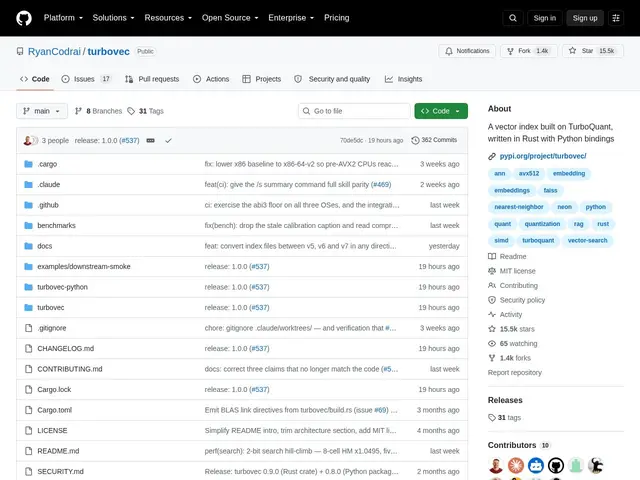
Description
Every AI app that does semantic search — "find documents similar to this one" — needs a vector index under the hood, and the classic choice, FAISS, can be memory-hungry and requires a training step before you can use it. turbovec is a newer alternative built specifically to be faster and leaner: no training phase, less memory per vector, and hardware-accelerated search.
turbovec is an open-source (MIT) Rust library implementing Google's TurboQuant algorithm, with Python bindings so it drops into existing AI/ML pipelines. It supports online ingestion (add vectors immediately, no training step), SIMD-accelerated search on both ARM and x86 hardware, a 16x compression ratio for memory efficiency, incremental saves with crash safety, and filtered search at query time. It plugs into common AI frameworks (LangChain, LlamaIndex, Haystack, Agno) and has grown to over 16,000 GitHub stars.
💬 Our review
The short version: if you're building a RAG system or any semantic search feature and currently default to FAISS out of habit, turbovec is worth a serious look — its own benchmarks claim roughly 3.4x faster search than FAISS's comparable quantized index, with better memory efficiency.
The core differentiator is architectural: FAISS generally requires a training step to build its index structure before you can search, which is awkward for systems where data keeps arriving; turbovec's online ingestion means you can add vectors and search immediately. The 16x compression ratio and SIMD acceleration (ARM NEON and x86 AVX-512) are also concrete, measurable advantages for teams running vector search at scale where memory and latency directly translate to infrastructure cost. Its ready-made integrations with LangChain, LlamaIndex and Haystack mean adopting it doesn't require rebuilding your RAG stack from scratch.
The honest limits: it's newer and has a smaller ecosystem and community track record than FAISS, which has years of production battle-testing across huge deployments. Native performance also assumes comfort with Rust if you need to go beyond the Python bindings. For a team building or optimizing a RAG/semantic-search pipeline where speed and memory matter, it's a compelling, free upgrade path to evaluate; for a team already deep into a stable FAISS deployment with no performance complaints, switching isn't urgent.
💰 Pricing
📊 Global score
🤖 AI-enriched data
Bibliothèque open-source (MIT), entièrement gratuite.
Pros
Environ 3,4x plus rapide que FAISS IndexPQFastScan (benchmarks du projet)
Ingestion en ligne sans phase d'entraînement préalable
Ratio de compression 16x et accélération SIMD (ARM NEON, x86 AVX-512)
Intégrations prêtes à l'emploi avec LangChain, LlamaIndex, Haystack
Cons
Écosystème et historique de production plus jeunes que FAISS
Performance native nécessite des connaissances Rust au-delà des bindings Python
Projet récent (mars 2026) malgré une adoption rapide