OpenKB
A free, open-source command-line tool that reads your documents (PDFs, Word files, spreadsheets...) and turns them into a linked wiki you can browse in Obsidian, using AI instead of manual note-taking.
🔗 Visit OpenKB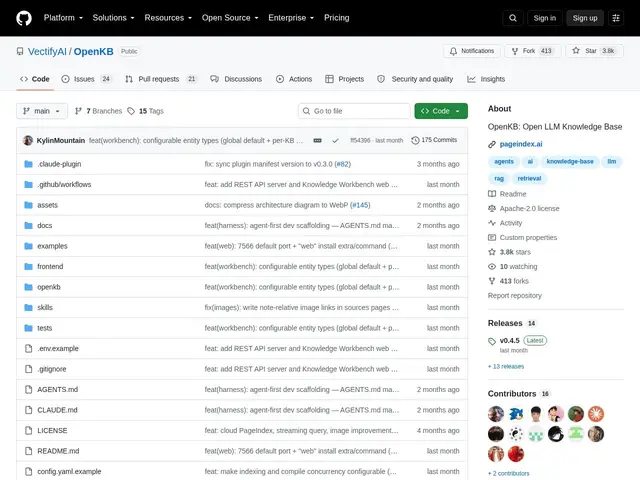
Description
Most people who try to build a knowledge base from a pile of documents end up doing it by hand — reading each file, writing a summary, linking it to related notes — which is slow and rarely kept up to date. OpenKB automates that: point it at a folder of documents and it reads them with an AI model, writes structured summary pages, and cross-links related topics automatically, so you end up with a browsable wiki instead of a flat pile of files.
OpenKB is an open-source (Apache 2.0) command-line tool built by VectifyAI. It ingests PDFs, Word docs, Markdown, PowerPoint, HTML, Excel and CSV files — including figures, tables and images — and compiles them into a persistent, interlinked Markdown wiki compatible with Obsidian's graph view. Instead of the usual RAG approach (chunk documents into a vector database and re-search on every query), it uses "vectorless" tree indexing via VectifyAI's PageIndex technology, meaning it reasons over full document structure rather than fragmented chunks — a better fit for long, structured documents. On top of the wiki foundation it adds generators for querying, chatting with your knowledge base, and a "Skill Factory" for turning compiled knowledge into reusable outputs. It supports multiple LLM providers (OpenAI, Claude, Gemini) via LiteLLM and the OpenAI Agents SDK, and has around 3.8k GitHub stars.
💬 Our review
The short version: if you have a folder of long, messy documents (reports, specs, research papers) and want an actual browsable wiki out of them instead of a vector database you can only query, OpenKB is one of the few open-source tools built specifically for that.
The real differentiator versus a typical RAG stack (LlamaIndex, LangChain + a vector DB) is the underlying retrieval approach: instead of chunking documents and hoping the right chunk gets retrieved, OpenKB's PageIndex-based tree indexing reasons over full document structure, which tends to hold up much better on long or heavily structured documents where chunk-based RAG loses context. Compared to Obsidian, the difference is automation — Obsidian is a excellent wiki *editor*, but you still write and link every note yourself; OpenKB compiles the wiki *for* you from raw source documents. Compared to Google's NotebookLM, OpenKB is self-hosted, open-source and produces a persistent, portable Markdown wiki you own, rather than a closed notebook you can only query inside Google's product.
The honest limits: it's a CLI tool, not a polished consumer app — a web UI is still in development, so setup and daily use assume you're comfortable in a terminal. It also requires your own LLM API keys to run, so there's a real (if usage-based) cost even though the tool itself is free. At 3.8k stars it's a young project relative to Obsidian's decade-plus ecosystem, so plugins and community support are thin. For a developer or researcher who wants an automatically-maintained, self-hosted knowledge wiki from a document pile, it's a genuinely useful and fairly unique tool; for someone who just wants to jot notes and link them manually, plain Obsidian is simpler.
💰 Pricing
📊 Global score
🤖 AI-enriched data
Outil open-source (Apache 2.0) gratuit ; nécessite vos propres clés API LLM (OpenAI/Claude/Gemini), donc un coût d'usage variable côté fournisseur du modèle.
Pros
Indexation "vectorless" (PageIndex) — meilleure tenue sur documents longs/structurés qu'un RAG classique par chunks
Compile automatiquement un wiki lié à partir de documents bruts (PDF, Word, Excel, PPT, HTML, CSV)
Gratuit et open-source (Apache 2.0), sortie Markdown compatible Obsidian
Multi-fournisseur LLM (OpenAI, Claude, Gemini) via LiteLLM
Cons
Outil en ligne de commande — pas d'interface web polie pour l'instant
Nécessite ses propres clés API LLM, donc un coût d'usage variable
Écosystème jeune (3,8k étoiles) comparé à Obsidian et ses plugins