AgentSecrets
A free proxy that lets AI agents make authenticated API calls without ever holding the actual API key in memory — the key stays in your OS keychain the whole time.
🔗 Visit AgentSecrets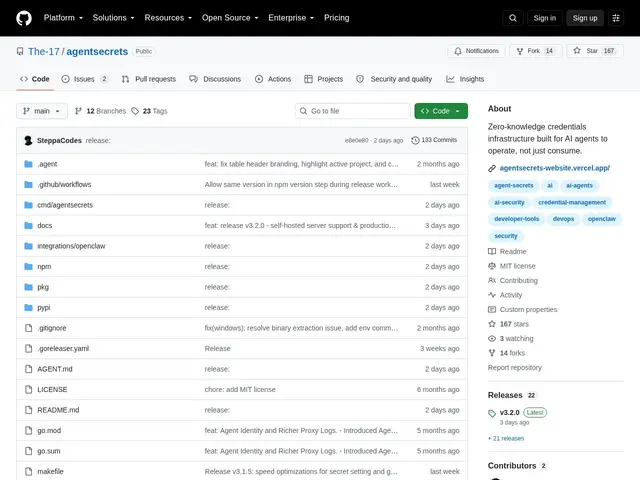
Description
Most 'AI agent has an API key' setups load that key straight into the agent's memory or environment, which means a prompt injection attack or a bug in the agent's reasoning can potentially expose it. AgentSecrets removes the key from that equation entirely: the agent only ever references a credential by name, and a local proxy fills in the real value at the network level, invisible to the agent itself.
AgentSecrets runs as a local loopback HTTP proxy. An agent workflow references a credential like GITHUB_TOKEN by name only; the proxy intercepts the outbound request, fetches the real value from the OS keychain, and injects it into the request header at the transport layer — the agent process only ever sees the final API response, never the raw key. It supports six different auth injection styles (bearer, header, query, basic, JSON body, form field), uses X25519 key exchange with AES-256-GCM encryption, keeps a SHA-256 audit trail, and ships MCP servers for Claude and Cursor plus OpenClaw support and a Python SDK. It's free, open-source, and MIT-licensed.
💬 Our review
The short version: AgentSecrets tackles the API-key-exposure problem for AI agents more thoroughly than most competitors by keeping the credential completely outside the agent's process at the network layer, not just hidden from its visible output.
The transport-layer injection is the real architectural strength here — tools that just redact secrets from what the agent 'sees' still technically load the key into the agent's own memory at some point, while AgentSecrets never lets it get there in the first place. Support for six different auth styles also means it can cover a lot of real-world API shapes, not just simple bearer tokens.
The honest gaps: it's still a smaller, community project (167 stars) rather than an enterprise-backed product, and running a local proxy adds a moving part to debug if something breaks mid-request. The marketing website was flaky at last check, though the GitHub repo itself is clearly active. For teams that want the strongest technical guarantee against agent credential leakage, it's worth the setup; for a lighter-weight fix limited to .env files specifically, Enject is simpler to adopt.
💰 Pricing
📊 Global score
🤖 AI-enriched data
Entièrement gratuit et open-source (MIT).
Pros
Injection au niveau transport — la clé n'entre jamais dans la mémoire de l'agent
Six styles d'injection d'authentification (bearer, header, query, basic, JSON, form)
Chiffrement X25519 + AES-256-GCM avec journal d'audit SHA-256
Serveurs MCP prêts à l'emploi pour Claude et Cursor
Cons
Projet communautaire encore modeste (167 étoiles), pas soutenu par une entreprise
Proxy local ajoute un composant supplémentaire à déboguer
Site marketing instable constaté au moment de la recherche