Enject
A free tool that swaps out your .env secrets for harmless placeholders on disk, so an AI coding assistant reading your project files never sees a real password or API key.
🔗 Visit Enject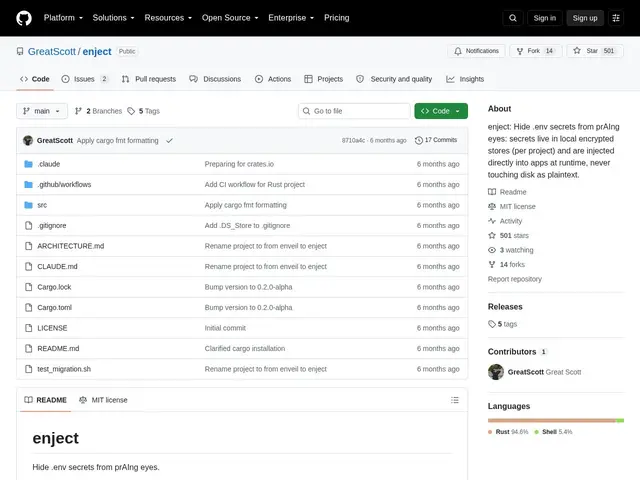
Description
AI coding tools like Claude Code, Copilot, and Cursor routinely read every file in a project directory — including .env files, which usually hold real API keys and database passwords in plaintext. Enject removes that risk at the source: your .env file only ever contains symbolic references like en://openai-key, while the actual secret value lives encrypted in a separate local vault and gets injected directly into the running process at launch.
Enject (formerly called enveil) is an open-source, MIT-licensed CLI tool using AES-256-GCM encryption with Argon2id key derivation and per-project encrypted stores. Commands like init, set, run, list, delete, import, and rotate cover the full lifecycle of managing secrets this way. Secrets are decrypted only in memory for the duration of a process launch and never touch disk as plaintext. It's a young project — v0.2.0-alpha — but has already picked up 501 GitHub stars, suggesting real developer interest in the exact problem it targets.
💬 Our review
The short version: Enject solves a specific, sharply-defined problem — a .env file full of real secrets sitting in a folder that an AI coding agent can freely read — and its symbolic-reference approach is a clean, low-friction fix that doesn't change how you write code.
The design is refreshingly narrow and honest about its limits: the README itself warns it's not a silver bullet and can't stop an agent that decides to write code that deliberately exfiltrates a secret at runtime. That kind of upfront caveat is a good sign for a security tool, since overclaiming security guarantees is a common red flag in this space.
The honest gaps: it's alpha software (v0.2.0), so expect rough edges and possible breaking changes, and it only protects the .env-reading attack vector specifically — it's not a general secrets manager with team sharing or cloud sync. For developers whose main worry is 'my coding agent can just cat my .env file,' it's a fast, free fix; for broader credential management across a team, something like Passbolt or 1Password covers more ground.
💰 Pricing
📊 Global score
🤖 AI-enriched data
Entièrement gratuit et open-source (MIT).
Pros
Solution ciblée et simple : references symboliques (en://) au lieu de vraies valeurs
Chiffrement AES-256-GCM + Argon2id, secrets jamais en clair sur disque
501 étoiles GitHub — adoption réelle pour un problème précis
Auteur transparent sur les limites (pas une solution miracle)
Cons
Encore en alpha (v0.2.0), changements cassants possibles
Ne protège que le vecteur .env, pas un gestionnaire de secrets complet
Ne peut pas empêcher un agent qui écrirait délibérément du code d'exfiltration