zcomplete
A lightweight command-line tool that learns from your shell history and suggests corrections when you mistype a command, across zsh, bash, and fish.
🔗 Visit zcomplete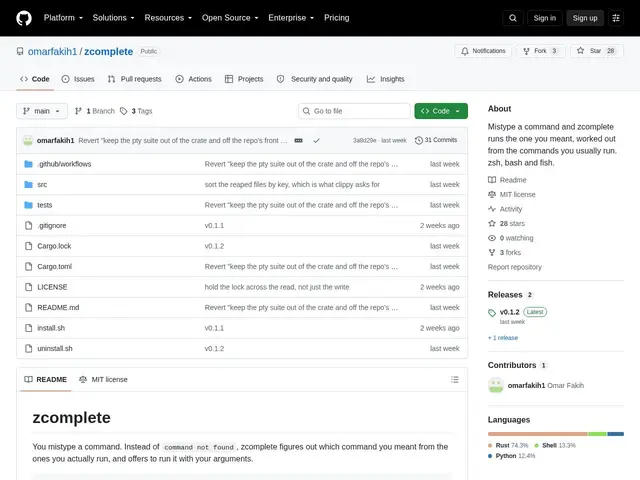
Description
Typo a shell command and most terminals just throw an error — you retype it yourself. zcomplete watches your command history, learns what you actually meant when you mistype something, and offers to run the corrected command for you, across zsh, bash, and fish.
It's a small Rust binary (~550KB, single dependency) that ranks candidate corrections by frequency, recency, and current-directory context, matching on prefixes, initials, subsequences, and typos — including subcommand-level correction (like fixing 'gt status' to 'git status'). It adds confirmation prompts for dangerous commands (rm, dd, git push --force) as a safety net, keeps its local database capped around 160KB in ~/.local/share/zcomplete, and claims roughly 0.067ms overhead per command on zsh/bash. It's MIT-licensed, installable via curl script or cargo, and very new — created in mid-August 2026 with 28 GitHub stars.
💬 Our review
The short version: if you spend a lot of time in the terminal and mistype commands often, zcomplete is a low-friction, genuinely lightweight fix — install it and it starts learning from how you actually work, for free.
Compared to shell-native fixes like zsh's built-in correction (fairly basic and can be annoyingly aggressive) or thefuck (a popular Python-based command corrector), zcomplete's pitch is speed and footprint — a tiny Rust binary with near-zero overhead versus thefuck's noticeably heavier Python runtime, plus safety prompts for destructive commands that thefuck doesn't emphasize as strongly. It's brand new (created 2 weeks before writing this), so the sample size on real-world reliability is small; the core idea and execution look solid, but expect some rough edges typical of a two-week-old project.
💰 Pricing
📊 Global score
🤖 AI-enriched data
100% gratuit, licence MIT. Installation via script curl ou cargo, aucune version payante.
Pros
Apprentissage à partir de l'historique réel de commandes (fréquence, récence, contexte)
Supporte 3 shells majeurs (zsh, bash, fish)
Prompts de confirmation pour les commandes dangereuses (rm, dd, git push --force)
Overhead minimal (~0.067ms par commande), binaire de ~550KB
Open-source MIT, installation simple
Cons
Projet très récent (créé mi-août 2026), peu de recul
Petite communauté (28 stars, 3 forks)
Peu de retours d'usage réel disponibles
Pas encore de discussions/issues documentées