PassManagerWeb
Self-hosted password manager built with Django, AES-256 GCM encryption, MFA, and brute-force protection.
🔗 Visit PassManagerWeb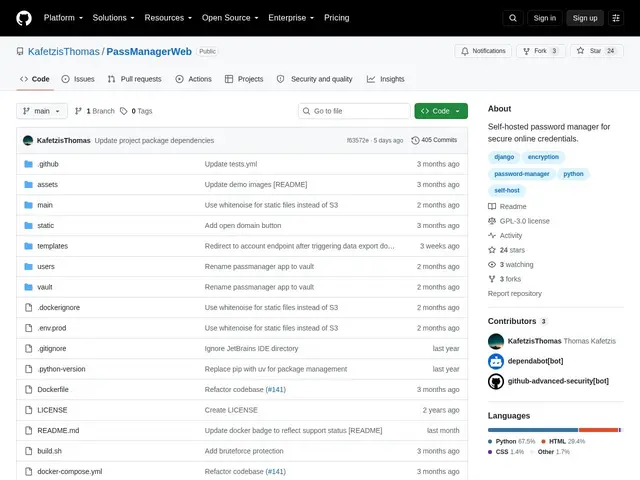
Description
Trusting a third-party company with every password you own is a leap of faith a lot of people would rather not make, especially after the last few years of credential-database breaches. PassManagerWeb is for the crowd that would rather run that database themselves.
PassManagerWeb is an open-source, self-hosted password manager built with Python and Django, using AES-256 GCM encryption with user-derived keys so the server operator never holds a usable copy of your vault. It includes multi-factor authentication, rate-limited brute-force protection, configurable vault timeout with auto-lock, weak-password detection, CSV import/export, and Discord webhook alerts for new account registrations — useful for a small self-hosted instance where you want to know immediately if someone new signs up.
💬 Our review
The short version: PassManagerWeb is a young, honest self-hosted password manager for people who specifically want to run their own Django app rather than trust Bitwarden's or 1Password's cloud infrastructure — but it's early enough that you should read the code before trusting it with real credentials.
Against Bitwarden (which itself supports self-hosting via Vaultwarden), PassManagerWeb doesn't offer browser extensions, mobile apps, or organizational sharing features — it's a web app you self-host and access through a browser, full stop. What it does offer is a full Django-based CRUD vault with real security fundamentals (AES-256 GCM, MFA, brute-force limiting) in a compact, auditable codebase. At 24 GitHub stars, it's a small, likely single-maintainer project, which matters a lot for something protecting your passwords: fewer eyes have reviewed it than Bitwarden's audited, widely-deployed codebase. For a developer who wants to self-host something minimal and is comfortable auditing the code themselves, it's an interesting option; anyone who wants browser autofill, mobile access, or a battle-tested project should use Vaultwarden or Bitwarden instead.
💰 Pricing
📊 Global score
🤖 AI-enriched data
Auto-hébergé gratuit, licence MIT
Pros
Chiffrement AES-256 GCM et MFA
Protection anti-bruteforce intégrée
Code Django compact et auditable
Gratuit et open-source
Cons
Pas d'extension navigateur ni d'app mobile
Très petit projet, peu audité
Pas de fonctions d'équipe/organisation