Slash
Self-hosted link shortener that turns scattered cloud URLs into memorable s/shortcut links, with browser extensions and analytics.
🔗 Visit Slash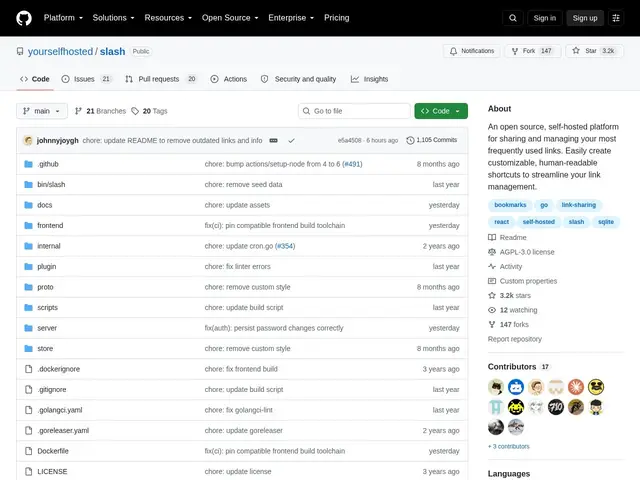
Description
Bookmarks scattered across emails, chat threads, and a dozen browser profiles eventually become impossible to find again. Slash's answer is to turn your most important links into short, memorable shortcuts — like s/roadmap or s/onboarding — that anyone on the team can type from memory.
Slash is an open-source, self-hosted link management tool built with a Go backend, React frontend, and SQLite database, deployable as a single Docker container. It lets individuals and teams create human-readable shortcuts for cloud links, share them publicly or privately through collections, and track traffic and referral sources with built-in analytics. Browser extensions for Chromium and Firefox let you create or jump to shortcuts without leaving the address bar, and the whole stack is licensed under AGPL-3.0.
💬 Our review
The short version: Slash is a clean, no-frills self-hosted alternative to internal link-shortener tools that larger companies build in-house, useful once your team has enough scattered links that "just bookmark it" stops working.
Compared to a general-purpose shortener like Kutt or Rebrandly, Slash's differentiator is the s/shortcut convention for internal team links plus lightweight browser extensions, which fits an internal-tooling use case better than a public marketing-link shortener. With around 3,200 GitHub stars, it has decent traction for a self-hosted internal tool, though its analytics are more basic than a dedicated link-tracking SaaS. Because it's self-hosted with a Docker deployment story and no official hosted tier, it fits teams already comfortable running small internal services; teams wanting a managed, no-maintenance link shortener with advanced analytics should look at a hosted product instead.
💰 Pricing
📊 Global score
🤖 AI-enriched data
Auto-hébergé gratuit, licence AGPL-3.0
Pros
Raccourcis mémorables type s/shortcut
Extensions navigateur Chromium/Firefox
Déploiement Docker simple
Statistiques de trafic intégrées
Cons
Pas d'offre hébergée
Analytics plus basiques qu'un SaaS dédié
AGPL-3.0 contraignante pour usage public modifié