OpenBot
An open-source way to let AI agents do real work — browsing, editing files, using tools — inside a locked-down sandbox where every action needs sign-off before it happens, like giving an intern a supervised desk instead of the keys to the building.
🔗 Visit OpenBot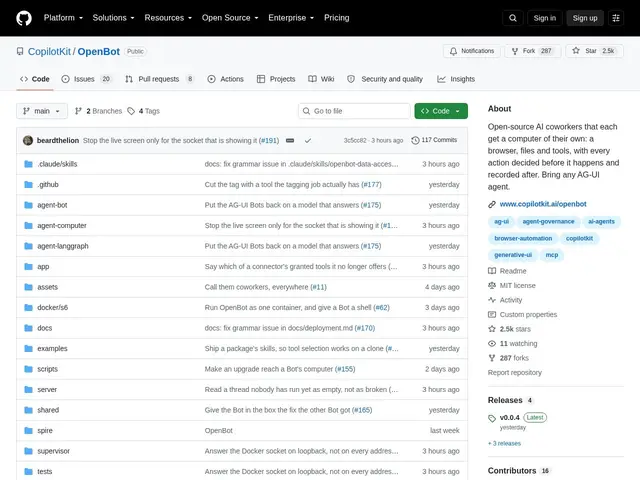
Description
Letting an AI agent loose on real tasks is useful but risky: it might browse the wrong site, delete the wrong file, or take an action nobody approved. OpenBot, from the team behind CopilotKit, addresses this by giving each agent its own isolated environment — a dedicated browser and file workspace — and routing every action through a policy engine for approval and an audit trail before it actually executes, rather than after the fact.
It's framework-agnostic, supporting LangGraph, Mastra, CrewAI, or hand-written agents, and ships React UI components so agent interactions can go beyond plain text chat. The policy engine uses CEL (Common Expression Language) rules, integrates with Model Context Protocol (MCP) for tool access, and supports enterprise authentication (Google, Microsoft, Okta, SAML, OpenID Connect) with encrypted credential storage. It's MIT-licensed, written in TypeScript, deployed via Docker Compose, requires PostgreSQL and the Bun runtime, and has crossed 2,500 GitHub stars while still in active Alpha development.
💬 Our review
The short version: OpenBot is aimed squarely at the question every team deploying agents eventually hits — "how do we let this thing act without trusting it blindly?" — and its answer (isolated sandboxes plus a mandatory policy gate) is a sound one for organizations that need real audit trails.
Against general agent frameworks like LangGraph or CrewAI, which OpenBot actually supports as backends, it's not a competitor so much as a governance layer on top — the real comparison is against other agent-deployment/governance platforms, where OpenBot's open-source, self-hosted, MIT-licensed nature is the differentiator versus closed enterprise offerings. Being in Alpha is the honest caveat here: 2,500 stars and active development are encouraging signs, but Alpha software means expect breaking changes and gaps, not production-hardened stability. For a security-conscious team piloting agent deployments who wants full control and an audit trail from day one, it's worth the setup cost (PostgreSQL, Bun, Docker Compose); teams wanting a quick, ungoverned agent demo should look elsewhere first.
💰 Pricing
📊 Global score
🤖 AI-enriched data
100% gratuit et open-source (licence MIT), auto-hébergé via Docker Compose.
Pros
Environnements isolés par agent (navigateur + workspace dédiés)
Moteur de politiques CEL avec approbation et piste d'audit avant chaque action
Agnostique au framework : LangGraph, Mastra, CrewAI, ou agents faits-main
Authentification entreprise complète (SAML, OpenID, Okta, Google, Microsoft)
Open-source MIT, 2500+ étoiles GitHub, développement actif
Cons
Statut Alpha : instabilité et changements cassants à prévoir
Stack de déploiement exigeante (PostgreSQL + Bun + Docker Compose)
Pas un framework agent en soi — nécessite d'en choisir un par-dessus
Documentation encore en construction pour un projet aussi jeune