OpenViking
An open-source "context database" for AI agents that stores memory, retrieved knowledge, and skills together as a browsable filesystem, so agents don't have to relearn everything each session.
🔗 Visit OpenViking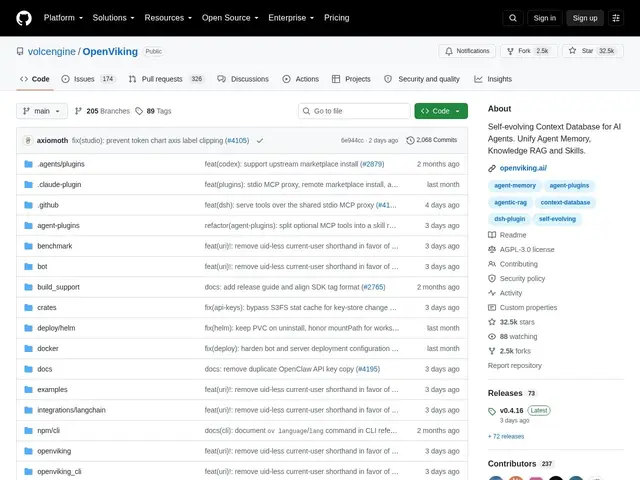
Description
AI agents that hold long conversations or work across many sessions run into the same wall: they forget everything once the context window resets, and stuffing all their prior knowledge back in gets expensive fast. OpenViking is built to fix that by giving an agent a persistent "filesystem" of its own — memory of past sessions, retrieved documents, and reusable skills — that it can browse the same way you'd browse folders, only loading the details it actually needs.
It works through a unified access protocol (viking://) with three-tier content loading — abstract, overview, then full detail — so agents pull in only as much text as a task requires, cutting token costs. It automatically converts past sessions into long-term memory, supports directory-based recursive retrieval with observable query trajectories, and integrates with Claude, OpenAI, LangChain, LangGraph, and MCP. Backed by ByteDance/Volcengine, it's dual-licensed (AGPLv3 for the core, Apache 2.0 for the CLI and examples), with a managed SaaS option on Volcano Engine for teams that don't want to self-host.
💬 Our review
The short version: for developers building agents that need to remember things across sessions without blowing through their token budget, OpenViking's tiered-loading approach is a genuinely useful piece of infrastructure, and it's free to self-host.
Compared to lighter memory libraries like Mem0 or Zep, which focus mainly on conversational memory, OpenViking's scope is broader — it unifies memory, RAG, and agent skills under one filesystem abstraction, which is more powerful but also a bigger concept to learn before you get value from it. The AGPLv3 license on the core project is worth flagging for commercial users: it's copyleft, so shipping a modified version inside a closed product has real legal implications the permissive Apache 2.0 CLI doesn't carry. Teams that just need simple chat memory are probably better off with Mem0 or Zep; teams building a more ambitious agent platform who are comfortable with AGPL (or willing to pay for the managed SaaS) get a lot more out of OpenViking.
💰 Pricing
📊 Global score
🤖 AI-enriched data
Cœur open-source gratuit (AGPLv3, CLI et exemples en Apache 2.0). Option SaaS managée payante disponible sur Volcano Engine pour les équipes qui ne veulent pas s'auto-héberger — tarifs non publiés.
Pros
Chargement en trois paliers (résumé, aperçu, détail) qui réduit vraiment la consommation de tokens
Unifie mémoire agent, RAG et compétences dans une seule abstraction type système de fichiers
Conversion automatique des sessions passées en mémoire long terme
Intégrations multiples : Claude, OpenAI, LangChain, LangGraph, MCP
Adoption forte : 32 500+ étoiles GitHub, soutenu par ByteDance/Volcengine
Cons
Licence AGPLv3 sur le cœur : implications légales réelles pour un usage commercial fermé
Protocole propre (viking://) à apprendre avant d'en tirer de la valeur
Option SaaS managée qui peut créer une dépendance à Volcano Engine
Abstraction multi-niveaux plus complexe qu'une simple librairie de mémoire conversationnelle