Modular
A platform for running and deploying AI models fast on almost any hardware — GPUs, CPUs, and specialized chips — without rewriting code for each one.
🔗 Visit Modular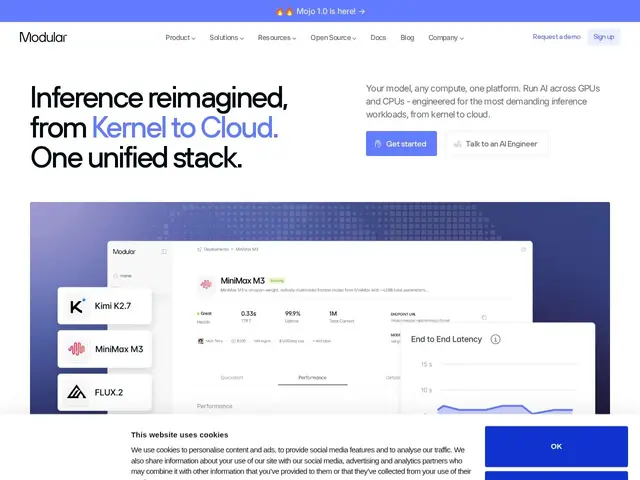
Description
Running an AI model in production is a different problem from training it: teams need it to answer fast, run cheaply, and work on whatever hardware they can get their hands on — Nvidia GPUs, AMD GPUs, or increasingly other specialized chips. Modular is a platform built to solve exactly that "last mile" problem, letting a model run efficiently across radically different hardware without an engineering team having to hand-optimize it for each one.
It's built around Mojo, a Python-interoperable programming language for systems-level and GPU performance, and MAX, a framework for hardware-agnostic inference across NVIDIA, AMD, TPU, Trainium, Intel, ARM, and Apple Silicon. It exposes OpenAI-compatible APIs, targets sub-500ms time-to-first-token, and supports three deployment modes: managed cloud, private cloud, or fully self-hosted. Benchmarks show 171% of vLLM's throughput on AMD MI355x hardware. The core is Apache 2.0 licensed, with MAX under the Modular Community License; the project has 29,000+ GitHub stars and active support for emerging model families like DeepSeek V3/R1 and Kimi K2.7.
💬 Our review
The short version: if you're deploying AI models to production and tired of your infrastructure choices being dictated by whichever GPU vendor you can get allocation from, Modular is worth a serious look — and free to try before committing to anything.
Compared to vLLM (open-source, but you manage your own serving infrastructure) or managed options like Baseten, Replicate, and Together AI (simpler to start, but tie you to their infrastructure and pricing), Modular's play is portability: write once, run on NVIDIA, AMD, or other accelerators without redoing the optimization work. The tradeoff is a smaller ecosystem and less battle-tested tooling than PyTorch/TensorFlow, plus Modular hasn't published transparent list pricing — you'll need to dig into the docs or talk to sales for real numbers. For a team locked into one cloud's GPUs with no plans to diversify, that portability may not matter; for anyone hedging against GPU scarcity or price swings, it's a legitimate differentiator backed by real benchmarks.
💰 Pricing
📊 Global score
🤖 AI-enriched data
Niveau gratuit pour expérimenter avec des modèles open-source. Facturation à l'usage (par token) pour les endpoints partagés, à la minute pour les endpoints dédiés. Auto-hébergement et cloud privé disponibles sans grille tarifaire publique — devis sur demande.
Pros
Portabilité matérielle réelle : NVIDIA, AMD, TPU et autres accélérateurs avec le même code
Performances mesurées : sub-500ms jusqu'au premier token, 171% du débit de vLLM sur AMD MI355x
APIs compatibles OpenAI, intégration facile dans une stack existante
Trois modes de déploiement (cloud géré, cloud privé, auto-hébergé)
Noyau open-source (Apache 2.0), communauté active (29 000+ étoiles GitHub)
Cons
Aucune grille tarifaire publique et transparente — il faut creuser ou contacter l'équipe
Écosystème et modèles pré-entraînés plus restreints que PyTorch/TensorFlow
Le compilateur Mojo n'accepte pas encore les contributions communautaires
Auto-hébergement exige une réelle expertise infrastructure