DoNotNotify
Free, open-source Android app that lets you write custom rules to filter, block, or hide notification content entirely on-device.
🔗 Visit DoNotNotify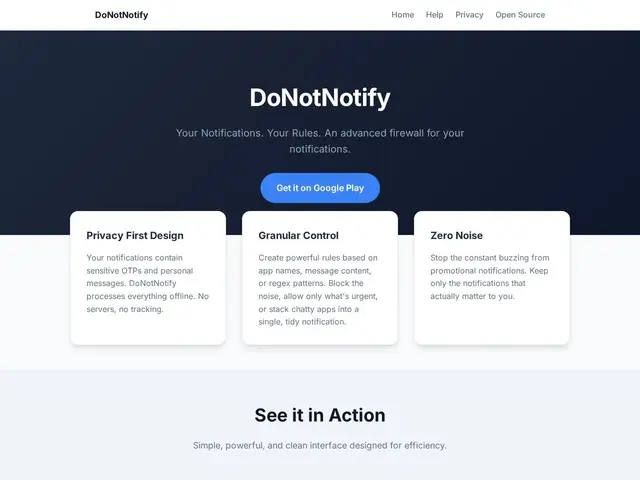
Description
If your phone buzzes non-stop with app alerts, marketing pings, and one-time codes, it's easy to miss the notification that actually matters — and just as easy for someone glancing at your lock screen to read a sensitive OTP or a personal message you didn't want visible. DoNotNotify is a free Android app that lets you write your own rules for which notifications get through, which get blocked, and which get quietly logged for later, all without sending a single byte of your notification data anywhere outside your phone.
Rules can match on app name, message content, or full regex patterns, so you can do things like hide the text of OTP codes while still letting the notification itself appear, group noisy apps into a single stacked entry, or block a specific contact's messages during work hours. Everything runs locally — DoNotNotify processes notifications on-device and never phones home, and the project is open source on GitHub, so the no-tracking claim is independently verifiable rather than just a promise in a privacy policy. It's built and maintained by a single developer with no monetization, which keeps it free but also means updates depend on one person's time rather than a company roadmap.
💬 Our review
The short version: for Android users who want fine-grained control over notifications without handing their data to another cloud service, DoNotNotify is a solid, genuinely free pick — the catch is it's Android-only and comes with the thin documentation typical of a solo open-source project.
Android already ships with per-app notification controls and a Do Not Disturb mode, and OEM skins like Samsung's One UI or MIUI add their own filtering layers — so DoNotNotify's real value is the regex-level rule engine and content-based filtering that stock Android doesn't offer, plus the peace of mind of fully offline processing that commercial notification managers (which often route data through their own servers for 'smart' filtering) don't provide. Compared to Android's native settings, DoNotNotify asks for more setup time in exchange for more precision; compared to a commercial cloud-based notification cleaner, it trades convenience features (cross-device sync, AI summarization) for a hard privacy guarantee. If you're on iOS, it's a non-starter; if you're an Android user who just wants less noise with minimal fuss, the built-in tools are probably enough.
💰 Pricing
📊 Global score
🤖 AI-enriched data
100% gratuit, open-source, aucune version payante ni compte requis.
Pros
Traitement 100% hors-ligne, aucune donnée envoyée à un serveur
Open-source et donc vérifiable
Moteur de règles avancé (nom d'appli, contenu, regex)
Entièrement gratuit, sans compte
Cons
Android uniquement, pas de version iOS
Projet solo, documentation limitée
Pas de synchronisation cloud des règles entre appareils