ZeroFS
ZeroFS lets you mount cheap S3-compatible cloud storage as a regular filesystem or disk on Linux, macOS, or Windows, encrypted and compressed automatically.
🔗 Visit ZeroFS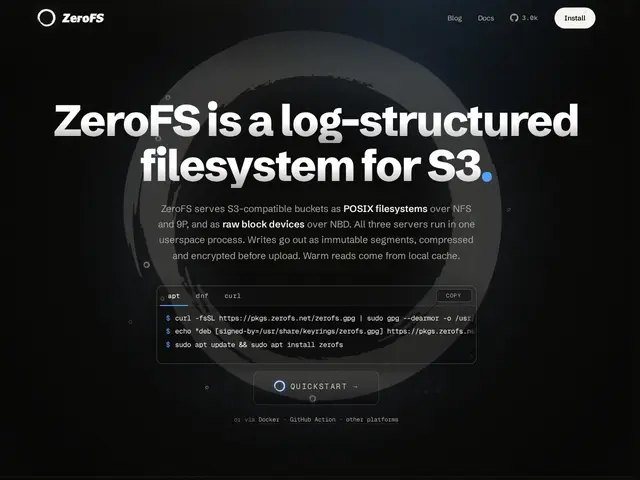
Description
Cloud object storage like S3 is cheap and durable, but it doesn't behave like a normal disk — you can't just open a folder in it, mount it, or point a regular application at it the way you would local storage. ZeroFS closes that gap: it takes S3-compatible storage and makes it look and behave like an actual filesystem or hard drive to your operating system, so tools and applications that expect regular files or a mounted disk just work, while your data actually lives in cheap, durable object storage behind the scenes.
Technically, it exposes storage through multiple protocols — NFS and 9P for POSIX-compliant filesystem access, and NBD for raw block device access — all running from a single userspace process with no external database dependency. Every file is encrypted with XChaCha20-Poly1305 before it's compressed (zstd or lz4) and uploaded, and it includes local caching across memory and disk tiers, geo-distributed mirroring across multiple S3 regions, read replicas, checkpoint functionality, and TRIM support so deleted space actually gets reclaimed rather than sitting unused. It's built to deliver near-raw-S3 throughput for large files while also scaling to hundreds of millions of small files, which is where naive S3-as-a-filesystem approaches usually fall apart. It's open source under GNU AGPL v3, with a commercial license available for organizations that need one, though commercial pricing isn't publicly listed.
💬 Our review
The short version: if you want S3's cost and durability without giving up POSIX-style file access — mounting storage like a drive rather than juggling an SDK — ZeroFS is a serious, well-engineered answer to a problem that's tripped up a lot of simpler S3-as-filesystem tools, especially its claim to scale to hundreds of millions of small files without falling over, which is the part that usually breaks.
The honest caveats: it's AGPL-3.0 licensed, which has real implications for any organization building a product on top of it and distributing that product, since AGPL requires making your own modifications available under the same license in many distribution scenarios — the commercial license exists specifically to sidestep that, but its pricing isn't public, so you'd need to contact the maintainers to know the real cost. It's also infrastructure software aimed at technical operators comfortable running a userspace filesystem daemon, not a plug-and-play consumer product; the payoff is real but requires genuine infra competence to deploy and trust in production.
💰 Pricing
📊 Global score
🤖 AI-enriched data
Gratuit sous GNU AGPL v3. Licence commerciale disponible pour contourner les contraintes AGPL, tarif non public (à demander).
Pros
Accès filesystem POSIX complet (NFS, 9P) et block device (NBD) sur S3
Chiffrement XChaCha20-Poly1305 + compression avant upload
Scalabilité annoncée à des centaines de millions de petits fichiers
Mise en cache multi-niveaux et réplication géo-distribuée entre régions S3
Cons
Licence AGPL-3.0 contraignante pour la distribution commerciale sans licence payante
Tarif de la licence commerciale non public
Nécessite une réelle expertise infra pour déployer et faire confiance en production