Skriptr
An AI workspace for students that helps you research a topic properly — ranking and organizing real sources instead of just answering questions — then helps you write the paper in stages instead of generating it in one shot.
🔗 Visit Skriptr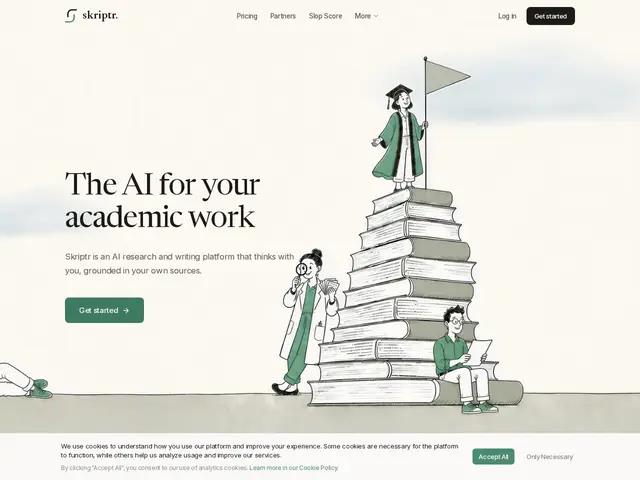
Description
Most AI writing tools either just answer your question or spit out a finished essay in one go, neither of which teaches you anything or produces work you can actually defend. Skriptr is built around the opposite idea: keep the student in the driver's seat, doing real research and real writing, with an AI that assists at each stage rather than replacing the work.
Skriptr splits into two parts. The Research Companion scopes a topic with you before searching academic databases, then hands back a ranked, sortable spreadsheet of sources instead of one fixed search result — closer to how you'd actually explore a field. The Writing Companion runs a staged pipeline (outline → draft → iterate → review) instead of one-shot generation, and includes a "Devil's Advocate" mode that argues both sides of your claims using source evidence, plus a reviewer that comments on your draft the way a supervisor would — every suggestion is something you accept or reject, not an automatic rewrite. Multiple people can work in the same document and source library at once, with admin/editor/viewer roles for group projects.
💬 Our review
The short version: if you're a student who wants AI help with research and writing without just outsourcing the thinking, Skriptr's staged process and source-grounded approach is built specifically to keep you doing the actual academic work.
Compared to a general tool like ChatGPT, Skriptr's advantage is structure: a literature review as an organized, ranked spreadsheet instead of a wall of text, and a writing pipeline that forces iteration instead of one-shot generation — which also happens to produce work that holds up better if your institution checks for AI-generated content. Against a dedicated academic writer like Jenni AI, Skriptr leans more into the research phase (source discovery and evaluation) rather than just sentence-level writing help. The free tier is thin (5 source uploads per project), so serious use pushes you to the $10/month Pro plan fairly quickly — reasonable for a single active semester of coursework, less so if you only need occasional help.
💰 Pricing
📊 Global score
🤖 AI-enriched data
Free (usage IA limité, 5 sources/projet) ; Pro 10 $/mois (usage étendu, 100 sources, transcription audio) ; Ultra 30 $/mois (usage maximal, accès anticipé) ; -33% en facturation semestrielle
Pros
Recherche académique organisée en tableau classé plutôt qu'une simple réponse générée
Pipeline d'écriture en étapes (plan → brouillon → itération → relecture), pas de génération en un clic
Mode Devil's Advocate qui challenge vos arguments avec des sources
Collaboration multi-utilisateurs avec rôles (admin/éditeur/lecteur)
Cons
Palier gratuit limité à 5 sources par projet
Pensé pour un usage académique soutenu, moins pertinent pour un usage ponctuel
Facturation mensuelle ($10-30) qui s'additionne sur plusieurs semestres
Dépend de vos propres sources : moins utile sans matériel de départ à digérer