StatusPal
A hosted page where a company tells its customers "yes, we know it's down, here's what's happening" during an outage — plus the monitoring and alerts that spot the outage in the first place.
🔗 Visit StatusPal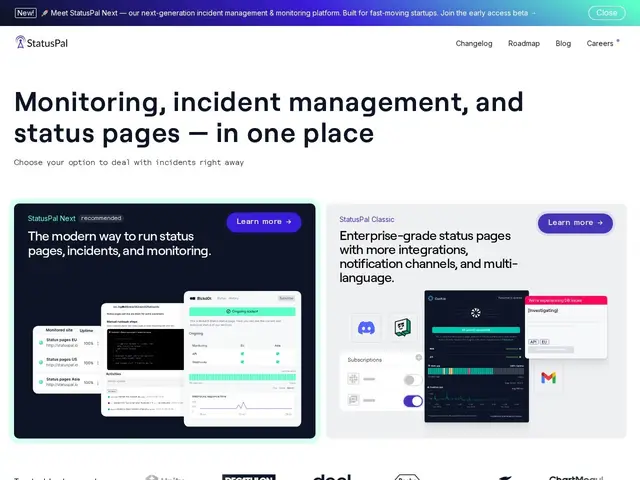
Description
When a service goes down, customers don't just want it fixed, they want to know someone noticed. A status page is that public-facing signal — a simple site showing what's up, what's degraded, and what the team is doing about it — and StatusPal packages the whole loop: detecting the problem, managing the incident internally, and communicating it externally.
StatusPal combines incident management, uptime monitoring and automations, and public/private status page hosting in one platform. Teams get collaboration tools for coordinating a response, multiple notification channels to alert subscribers the moment something breaks, support for up to three languages depending on plan, custom domains for the status page, and Single Sign-On from the Business tier up — aimed at DevOps teams, CTOs and incident commanders who need to keep stakeholders informed during an outage without hand-writing updates on Twitter.
💬 Our review
The short version: StatusPal does the unglamorous but genuinely important job of an incident status page well — monitoring, incident workflow, and a public page in one subscription instead of stitching three tools together.
At $46/month for the Hobby tier (5 team members, 500 subscribers, 10 services), it's priced for a small team already past the "we'll just tweet it" stage, and it jumps to $99 and $299 quickly as team size and subscriber counts grow — worth comparing against Atlassian Statuspage or Instatus, which compete in the same bracket with similar or sometimes cheaper entry tiers. The 14-day free trial with no credit card is a low-friction way to check whether the multi-language support and SSO (from Business up) actually matter for your setup before paying; if you just need a bare-bones public status page with no monitoring attached, a free tool like Instatus's basic tier will do it for less.
💰 Pricing
📊 Global score
🤖 AI-enriched data
Hobby : 46 $/mois (5 membres, 500 abonnés, 10 services). Startup : 99 $/mois (20 membres, 1000 abonnés, 30 services). Business : 299 $/mois (50 membres, 4000 abonnés, 100 services, SSO inclus). Enterprise : sur devis.
Pros
Monitoring + gestion d'incidents + page de statut publique dans un seul abonnement
Essai gratuit 14 jours sans carte bancaire
Support multilingue (jusqu'à 3 langues selon le plan) et domaine personnalisé
SSO disponible dès le plan Business
Cons
46 $/mois d'entrée, en hausse rapide (99 $ puis 299 $) selon la taille d'équipe et le nombre d'abonnés
Pas de plan gratuit permanent, contrairement à certains concurrents pour un simple statut public basique
Face à Atlassian Statuspage ou Instatus, la différenciation se joue surtout sur le prix d'entrée