Polygres
Turns a Postgres database into working memory for AI agents, with hybrid search across relational, graph, and vector queries in one call.
🔗 Visit Polygres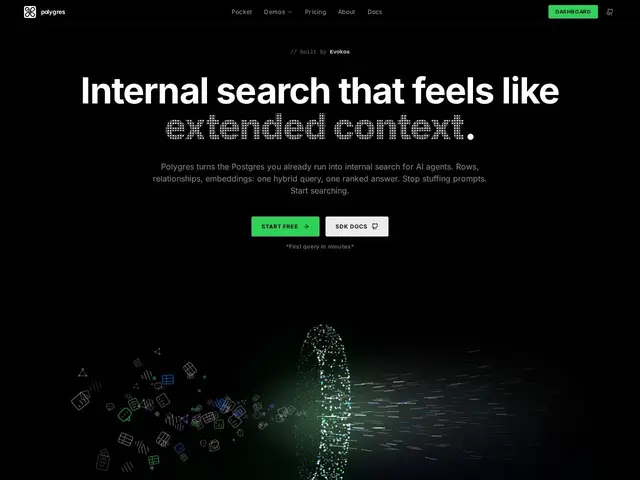
Description
Give an AI agent access to your app's data and you usually end up bolting on a separate vector database, syncing it with your real database, and hoping the two never drift out of sync. Polygres skips that whole extra system: it works directly on the Postgres database you already have and turns it into something an AI agent can query like extended memory.
💬 Our review
The short version: Polygres solves a real, specific pain — the vector-store-plus-sync-pipeline tax most teams pay to give an AI agent semantic search over their own data — by building hybrid retrieval (structured rows, graph relationships, semantic and full-text search) directly on top of Postgres via two open-source extensions, pgGraph and pgContext.
The self-hosted, open-source path is genuinely free, which is the right first step for evaluating whether the hybrid-retrieval approach fits your data before paying anything. But the managed tiers escalate fast: Launch is $16/month (temporarily free for early users, so expect that to end), Scale starts at $256/month minimum, and Enterprise starts at $4,096/month minimum — pricing clearly aimed at funded teams with production AI-agent workloads, not side projects. Compared to running a dedicated vector database (Pinecone, Weaviate) alongside your Postgres instance, Polygres is a meaningfully simpler architecture if your data already lives in Postgres; it's the wrong fit if your data doesn't, since the entire pitch depends on that database being your source of truth.
💰 Pricing
📊 Global score
🤖 AI-enriched data
Auto-hébergé : gratuit (extensions open-source pgGraph et pgContext). Launch : 16 $/mois (gratuit temporairement pour les premiers utilisateurs). Scale : à partir de 256 $/mois minimum. Enterprise : à partir de 4 096 $/mois minimum.
Pros
Recherche hybride (relationnel + graphe + sémantique + plein texte) en un seul appel
Fonctionne directement sur Postgres existant — pas de pipeline de synchronisation séparé
Extensions open-source (pgGraph, pgContext) sous licence Apache-2.0
Compatible Supabase, Neon et toute connexion Postgres standard
Cons
Paliers managés chers dès qu'on dépasse l'auto-hébergement (256 $/mois minimum pour Scale)
Le plan Launch gratuit est temporaire, pas une politique tarifaire durable
Utile seulement si les données vivent déjà dans Postgres
Produit jeune, écosystème et retours d'expérience encore limités