Panoptic Scans
An automated vulnerability scanner that runs OpenVAS, ZAP, Nmap and Nuclei against your network and web apps on a schedule, and reports findings in plain-language attack narratives instead of raw scanner output.
🔗 Visit Panoptic Scans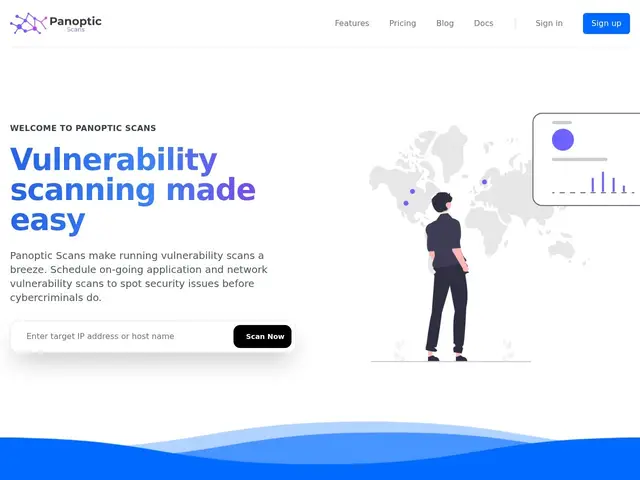
Description
Vulnerability scanning tools have a well-known usability problem: the best open-source scanners (OpenVAS, ZAP, Nmap) are genuinely powerful, but running them yourself means managing separate tools, schedules and infrastructure, and their raw output reads like a wall of CVE IDs that's hard to act on without a dedicated security engineer. Panoptic Scans packages those same open-source engines into a managed, scheduled service and translates the findings into readable 'attack narrative' reports, so a smaller team can get continuous scanning without hiring a full security function.
The platform combines OpenVAS (network vulnerability assessment), ZAP (web application scanning), Nmap (port/service detection) and Nuclei for automated, scheduled scans covering OWASP Top 10 web app issues and network misconfigurations, with email alerting, white-label reporting for agencies/MSPs, and Vanta integration for teams tracking SOC 2 compliance. Pricing is Basic ($25/month, 75 targets), Premium ($75/month, 300 targets) and Pro ($200/month, 7,500 targets), with a 10% discount on annual billing.
💬 Our review
The short version: Panoptic Scans' actual value isn't the scanning engines themselves — OpenVAS, ZAP and Nmap are free and well-known — it's that you don't have to run and maintain that infrastructure yourself, and the plain-language attack-narrative reporting is genuinely more usable for a team without a dedicated security analyst than raw scanner output.
At $25/month for 75 targets, it undercuts most managed vulnerability-scanning competitors that typically start well into three figures per month, and the Vanta integration is a smart addition for the specific audience of startups doing SOC 2 for the first time and needing scan evidence without hiring a security hire. The tradeoff is that it's built on the same open-source engines anyone can self-host for free — you're explicitly paying for infrastructure, scheduling and readable reporting rather than a proprietary detection engine, so a team with in-house security expertise willing to run OpenVAS/ZAP themselves gets the same underlying coverage for the cost of a server. Good fit for an early-stage SaaS company that needs continuous vulnerability scanning and SOC 2-ready evidence without a security hire; a larger security team with existing tooling may not need to pay for what they can already run themselves.
💰 Pricing
📊 Global score
🤖 AI-enriched data
Basic : 25 $/mois (75 cibles). Premium : 75 $/mois (300 cibles). Pro : 200 $/mois (7 500 cibles). -10% en facturation annuelle.
Pros
Combine 4 moteurs de scan éprouvés (OpenVAS, ZAP, Nmap, Nuclei) en un service géré
Rapports en langage clair plutôt qu'une sortie brute de scanner
Prix d'entrée bas (25 $/mois, 75 cibles)
Intégration Vanta pour les équipes visant SOC 2
Cons
Repose sur des moteurs open source auto-hébergeables gratuitement
Aucune information sur le financement ou l'ancienneté de l'éditeur
Marque blanche réservée à certains paliers
Pas de détection propriétaire différenciante au-delà de l'agrégation