Ubiq Security
Finds where a company's sensitive data actually lives across all its databases and apps, figures out who can access it, and then locks it down — instead of just encrypting everything blindly and hoping that's enough.
🔗 Visit Ubiq Security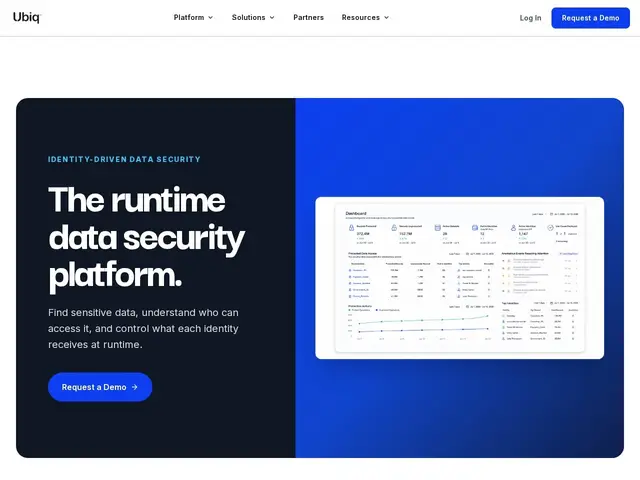
Description
Most companies don't actually know where all their sensitive data lives — it's scattered across databases, warehouses, and applications that grew organically over years. Ubiq Security starts by finding that data, then works out exactly who (or what system) can reach it before deciding how to protect it.
Ubiq Security is an identity-driven data security platform that discovers sensitive data across databases, warehouses, and applications, maps which identities can access which datasets, and enforces runtime controls — encryption, tokenization, masking — based on policy. It integrates with more than 46 systems, including databases, data warehouses, identity providers, and APIs, letting it plug into an organization's existing IAM setup (Okta, Azure, AWS) rather than requiring a separate access-control layer.
💬 Our review
The short version: if your security team knows encryption is necessary but keeps struggling to figure out where sensitive data actually sits and who can touch it, Ubiq's identity-first discovery approach addresses the harder problem before the encryption step even starts.
Against HashiCorp Vault or Fortanix, which are primarily secrets/key-management infrastructure, Ubiq's differentiator is starting from data discovery and identity mapping rather than assuming you already know what needs protecting — it answers "where is my sensitive data and who can see it" before applying encryption, tokenization, or masking. That's a genuinely harder and more valuable problem for large, sprawling data estates, but it also means implementation is more involved than dropping in a secrets manager: you're integrating identity providers, databases, and warehouses across the org, not just an API for encrypting values. Pricing isn't public, which is standard for platforms selling into enterprise/financial/government buyers but makes it hard to gauge fit for a smaller company. Best fit: enterprises, financial institutions, and government agencies with sprawling data estates who need to know not just how to encrypt data but who can access it and why. Weaker fit: smaller companies or startups needing straightforward secrets/key management — Vault or a cloud-native KMS is simpler and cheaper for that narrower need.
💰 Pricing
📊 Global score
🤖 AI-enriched data
Tarification non publique, sur devis auprès du service commercial.
Pros
Contrôles d'accès pilotés par l'identité, sans casser les workflows existants
Plus de 46 intégrations (bases de données, entrepôts, IdP, API)
Approche zero-trust avec protection granulaire au niveau enregistrement/fichier
Compatible avec l'IAM existant (Okta, Azure, AWS)
Cons
Tarification non publique, contact commercial obligatoire
Documentation en libre-service limitée
Mise en œuvre complexe à grande échelle