KeyHippo
Lets a Supabase app check "is this API key allowed to see this row" directly inside the database itself, instead of writing that permission logic separately in application code.
🔗 Visit KeyHippo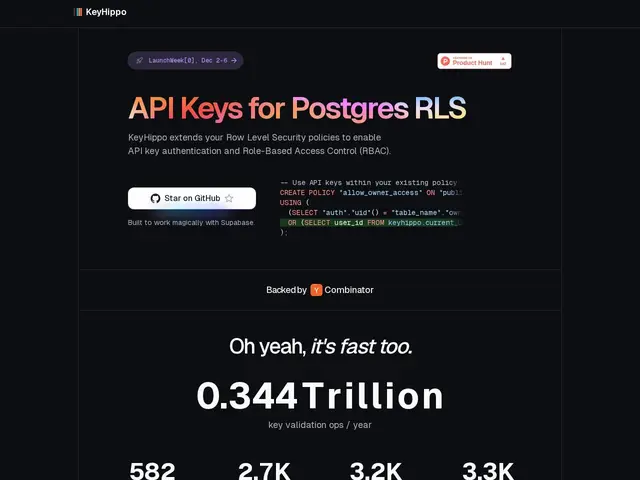
Description
Most apps handle API-key permissions in application code, separate from the database's own row-level security rules — which means two systems can drift out of sync and create security gaps. KeyHippo puts API-key authentication directly into the database's permission rules so there's only one source of truth.
KeyHippo is a PostgreSQL extension that adds API key authentication directly to Row Level Security (RLS) policies, purpose-built for Supabase environments. It provides API key management, role-based access control (RBAC), user impersonation for debugging, and complete authentication workflows, all enforced inside the database itself rather than in a separate middleware layer.
💬 Our review
The short version: if you're building on Supabase and currently juggling separate application-level permission checks alongside your RLS policies, KeyHippo's database-native approach collapses that into one system worth evaluating on a side project first, given how young it still is.
Against Supabase's own built-in Auth or a general provider like Auth0, KeyHippo's angle is architectural: it doesn't replace your auth provider, it extends Postgres RLS itself to understand API keys, so permission logic lives in the same place as your data access rules instead of split across a middleware layer and the database. That's elegant for teams who've hit the pain of keeping app-level and database-level permissions in sync, but it also means you're depending on a young, MIT-licensed open-source project (59 GitHub stars) rather than an established auth vendor — there's no commercial support tier or SaaS offering if something breaks in production. Being Y Combinator-backed is a signal of momentum, not a guarantee of longevity for a project this new. Best fit: Supabase-native teams who want API-key permissioning enforced at the database level and are comfortable relying on a young open-source project. Weaker fit: teams outside the Supabase/Postgres ecosystem, or anyone needing commercial support guarantees — Auth0 or Supabase's own Auth are safer bets there.
💰 Pricing
📊 Global score
🤖 AI-enriched data
Open source sous licence MIT. Aucun palier payant ni offre commerciale.
Pros
S'intègre directement aux politiques RLS de PostgreSQL
Conçu spécifiquement pour l'écosystème Supabase
Soutenu par Y Combinator
Performance revendiquée élevée sur un seul cœur
Cons
Limité aux environnements PostgreSQL/Supabase
Projet jeune (59 étoiles GitHub)
Pas de support commercial ni d'offre SaaS