UserJot
Gives SaaS teams one public place to collect feature requests, show a roadmap of what's coming, and publish changelogs — instead of feedback scattered across email, Slack, and support tickets.
🔗 Visit UserJot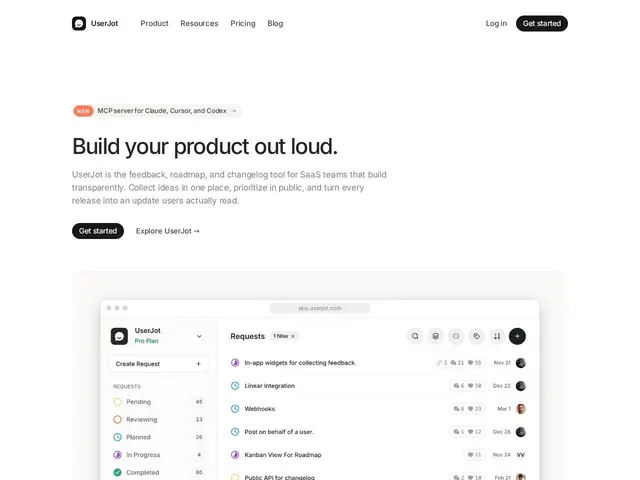
Description
Feature requests usually die in three places: a support ticket that gets closed, a Slack message nobody revisits, and an email that gets buried. UserJot gives users one public spot to submit and vote on ideas, gives the team one place to see what's actually wanted, and closes the loop by telling users when their idea shipped.
UserJot is a feedback, roadmap, and changelog tool built for SaaS teams that want to build in public. It provides feedback boards with voting and threaded comments, a public roadmap tied directly to feedback status changes, AI-drafted changelog posts, an embeddable in-app widget, custom domains and white-labeling, and integrations with Slack, Linear, Discord, a REST API, webhooks, and an MCP server. Every plan supports unlimited users, with paid tiers unlocking more boards, integrations, and SSO.
💬 Our review
The short version: at $0 for a genuinely usable free tier (unlimited users, 2 boards, public roadmap and changelog), UserJot is worth trying before comparing it to the established players — the real decision point is whether you need more than 2 boards or SSO, which is where the $29-59/month tiers kick in.
Its differentiator against a heavyweight like Productboard or Aha! is simplicity and price: those tools are built for larger product teams with complex prioritization workflows, while UserJot is a leaner loop of feedback → roadmap → changelog aimed at smaller SaaS teams that want to look transparent without a steep learning curve. Canny is the closest comparison in both scope and audience — the MCP server integration (letting AI tools read/write feedback data) is a genuinely newer differentiator neither Canny nor Productboard emphasize as much. The trade-off is that a small, product-led team's needs may outgrow it if the product get complex enough to need Aha!'s deeper roadmapping and dependency tracking. Best fit: SaaS teams that want a simple, public feedback-to-changelog loop without enterprise roadmapping overhead. Weaker fit: large product orgs needing multi-team roadmap dependencies and portfolio-level planning — Aha! or Productboard scale further there.
💰 Pricing
📊 Global score
🤖 AI-enriched data
Gratuit (utilisateurs illimités, 2 boards). Starter 29 $/mois (domaine perso, 5 boards). Professional 59 $/mois (boards illimités, SSO).
Pros
Palier gratuit réellement utilisable (utilisateurs illimités, 2 boards)
Boucle complète feedback → roadmap → changelog dans un seul outil
Changelog rédigé par IA à partir des évolutions du produit
Intégrations Slack, Linear, Discord, API REST, webhooks, serveur MCP
Widget intégrable directement dans l'application
Cons
Seulement 2 boards sur le gratuit, 5 sur Starter
Moins de profondeur qu'Aha!/Productboard pour la roadmap multi-équipes
SSO réservé au palier le plus cher (59 $/mois)
Marque encore jeune comparée à Canny ou Productboard