Pinguzo
Watches your websites, APIs, and servers around the clock and pings you on Slack, Discord, email, or a webhook the moment something goes down or a disk is about to fail.
🔗 Visit Pinguzo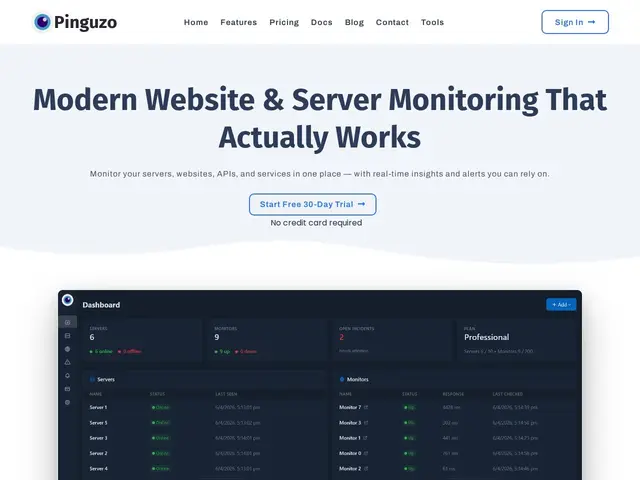
Description
Finding out your site is down because a customer emailed you about it is one of the worst ways to learn — by then it's already cost you traffic, trust, or sales. Pinguzo checks your sites, APIs, and servers on a schedule from multiple locations, and tells you the second something breaks, before your users have to.
Pinguzo is a real-time monitoring platform covering websites, APIs, TCP services, and DNS, plus deeper server health metrics like CPU, RAM, disk usage, and SMART disk-failure detection. It supports multi-channel alerts (email, Slack, Discord, Telegram, webhooks), branded public status pages, SSL expiry tracking, content-change detection, and full data export via a REST API — checking from multiple locations to cut down on false alarms from a single flaky network hop.
💬 Our review
The short version: at $2.50/month for the Personal tier, Pinguzo undercuts most competitors on price while still covering server-level metrics (SMART disk health, CPU/RAM) that some pure uptime checkers skip entirely.
Its differentiator against UptimeRobot or Pingdom is scope: those are primarily website/API uptime checkers, while Pinguzo folds in actual server health monitoring (disk failure prediction, resource usage) alongside the usual HTTP/TCP/DNS checks — useful if you're self-hosting rather than running everything behind a managed platform. Better Uptime remains the stronger pick if status-page polish and incident management workflows matter more to you than raw price. The free tier (1 server, 5 monitors, 5-minute checks) is genuinely usable for a small personal project, not just a crippled trial. Best fit: developers and small teams running their own servers who want both uptime alerts and hardware health warnings in one dashboard, at a low price. Weaker fit: a team that needs polished incident management and on-call scheduling — Better Uptime is more built out for that.
💰 Pricing
📊 Global score
🤖 AI-enriched data
Gratuit (1 serveur, 5 moniteurs). Personal 2,50 $/mois. Mini 4 $/mois. Professional 15 $/mois. Business 60 $/mois (100 serveurs, 2 000 moniteurs).
Pros
Surveille aussi la santé matérielle des serveurs (SMART, CPU, RAM), pas juste l'uptime HTTP
Vérification multi-localisation pour éviter les fausses alertes
Alertes multi-canaux (email, Slack, Discord, Telegram, webhooks)
Pages de statut personnalisées et export de données (JSON/CSV)
Prix d'entrée très bas (2,50 $/mois)
Cons
Moins connu et moins de retours d'expérience que UptimeRobot ou Pingdom
Gestion d'incidents/astreinte moins aboutie que Better Uptime
Palier gratuit limité à 1 serveur et 5 moniteurs
Intervalle de vérification à 5 min sur le gratuit, insuffisant pour du critique