Offsend
A gitignore-style rulebook for AI coding assistants: you list which files and secrets should never be shown to Cursor, Claude Code, or Windsurf, and Offsend blocks them locally before the agent ever sees your repo.
🔗 Visit Offsend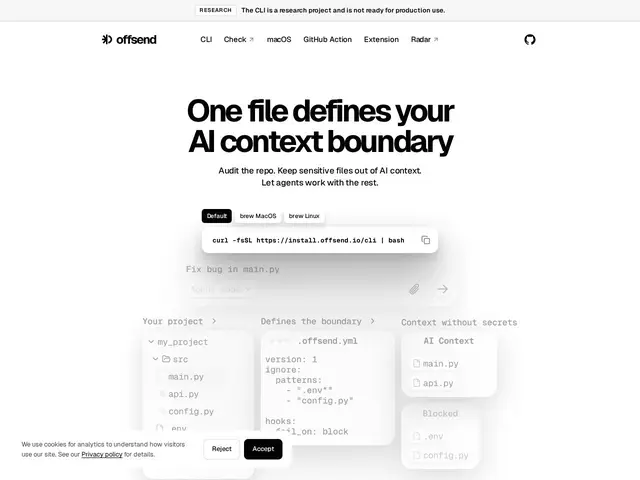
Description
AI coding assistants like Cursor or Claude Code work by reading through a codebase — which is exactly the problem, because that codebase might also contain a `.env` file full of API keys, a test fixture with real customer data, or internal notes nobody meant to hand to a third-party model. Most people rely on remembering to keep that stuff out of the way, which fails eventually. Offsend automates the memory: like a `.gitignore` file, but for what an AI agent is allowed to read.
Offsend is an open-source, local-first boundary layer for AI coding agents. A single `.offsend.yml` config file defines which paths and patterns are off-limits, and runtime gates enforce that boundary for supported tools (Cursor, Codex, Windsurf, Claude Code). It scans content for API keys, tokens, and other sensitive patterns entirely on-device — nothing is uploaded to a cloud service to do the check. The project also ships a CLI, git-hook integration to catch secrets before a commit, and a browser extension that masks sensitive text (keys, emails, phone numbers) before it's pasted into a web-based AI chat. The homepage is explicit that this is a research project, not yet production-ready — worth knowing before building a security policy around it.
💬 Our review
The short version: Offsend is a genuinely useful idea executed by a project that openly admits it isn't ready yet — worth bookmarking and trying on a side project, not worth building a company security policy around today.
The core concept is sound: as AI coding agents get wider read access to a codebase, having a declarative, local-only boundary for what they're allowed to see is a real gap that established secret scanners like Gitleaks or TruffleHog don't quite fill, since those scan for leaked secrets after the fact rather than gating access before an agent ever reads a file. Offsend's local-first design (no cloud upload) is the right architecture for a security tool. But the homepage itself says this is a research project, the pricing page 404s, and there's no visible track record or case study to lean on. That's not a red flag of bad intent — it just means the honest use case right now is a developer curious to try it on a personal repo, not a team that needs a dependable control it can point to in a security review.
💰 Pricing
📊 Global score
🤖 AI-enriched data
Open source, aucun modèle payant identifié sur le site. Page /pricing renvoie une 404 au moment de la vérification.
Pros
Traitement 100% local, aucune donnée envoyée dans le cloud pour la vérification
Open source et gratuit
Couvre plusieurs surfaces : CLI, hooks git, extension navigateur — pas juste un seul point de contrôle
Fonctionne avec plusieurs outils IA (Cursor, Claude Code, Windsurf, Codex), pas un seul vendor
Cons
L'éditeur affiche lui-même sur la page d'accueil que c'est un projet de recherche, pas prêt pour la production
Page tarifs en 404, signe d'un site encore incomplet
Équipe et antériorité inconnues, pas de cas d'usage publiés
Pas d'essai de fiabilité indépendant disponible à ce stade