Superpowers
A free, open-source set of "skills" that teaches AI coding agents to actually follow good engineering practice — writing a failing test first, debugging systematically, planning before coding — instead of guessing its way to working code.
🔗 Visit Superpowers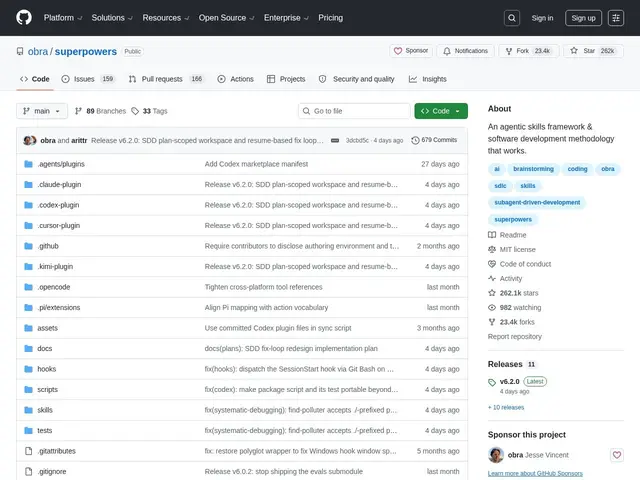
Description
AI coding agents left to their own devices often skip the boring-but-important parts of software engineering: they'll write code without a test to prove it's needed, patch a bug without figuring out why it happened, or start implementing before agreeing on what "done" looks like. Superpowers is a library of structured instructions ("skills") that steers an agent through the same disciplined workflow a good senior engineer follows — brainstorm, specify, plan, implement, review — instead of improvising.
Created by Jesse Vincent and Prime Radiant and released under the MIT license in October 2025, Superpowers bakes in test-driven development (RED-GREEN-REFACTOR) and a systematic root-cause debugging methodology as composable, swappable skills rather than a rigid script. It works across 11+ coding agent platforms — Claude Code, Cursor, GitHub Copilot CLI, Gemini CLI, and others — so it's not locked to a single vendor's ecosystem. It has grown explosively since launch, passing 260,000 GitHub stars in under a year, making it one of the most widely adopted "agent methodology" projects to date, with commercial support available for teams that want it.
💬 Our review
The short version: Superpowers is the closest thing to an industry-standard methodology for making AI coding agents behave like disciplined engineers rather than confident guessers, and its explosive adoption (260k+ stars) is a genuinely strong signal that it's solving a real, widely-felt problem — it's free, so trying it costs nothing but a bit of setup time.
Against LangChain's agent templates, which give you building blocks for constructing an agent's capabilities and tool access, Superpowers operates at a different layer: it's not about what tools an agent can call, but how it behaves once it's working on a task — the discipline layer sits on top of whatever agent framework or harness you're already using. Against CrewAI and AutoGPT, both frameworks for orchestrating multiple autonomous agents toward a goal, Superpowers isn't a multi-agent orchestrator at all; it's closer to a set of best-practice instructions a single agent (or your existing multi-agent setup) can follow. The honest caveat is that a methodology is only as good as an agent's willingness to actually follow it — LLM-driven agents can still deviate from a prescribed workflow under complex or ambiguous tasks, and being less than a year old means best practices around it are still being written by the community in real time. If you're already using Claude Code, Cursor, or a similar agent-driven workflow and finding the output undisciplined (skipped tests, unclear root causes, scope creep), it's worth adopting; if you're building a custom multi-agent orchestration system from scratch, it complements rather than replaces frameworks like CrewAI.
💰 Pricing
📊 Global score
🤖 AI-enriched data
Licence MIT, open source, gratuit ; support commercial disponible en option auprès de Prime Radiant.
Pros
Workflows TDD (RED-GREEN-REFACTOR) intégrés nativement comme compétences composables
Compatible avec 11+ plateformes d'agents de codage (Claude Code, Cursor, Copilot CLI, Gemini CLI...)
Méthodologie de debug systématique avec analyse de cause racine
Cons
Sortie récente (octobre 2025), bonnes pratiques encore en construction par la communauté
Un agent LLM peut toujours dévier de la méthodologie sur des tâches ambiguës
Nécessite un agent compatible et une intégration correcte pour être vraiment suivi