Hubble
A free, open-source note-taking app built for a world where both you and an AI agent might be editing the same notes — plain markdown files, no vendor lock-in.
🔗 Visit Hubble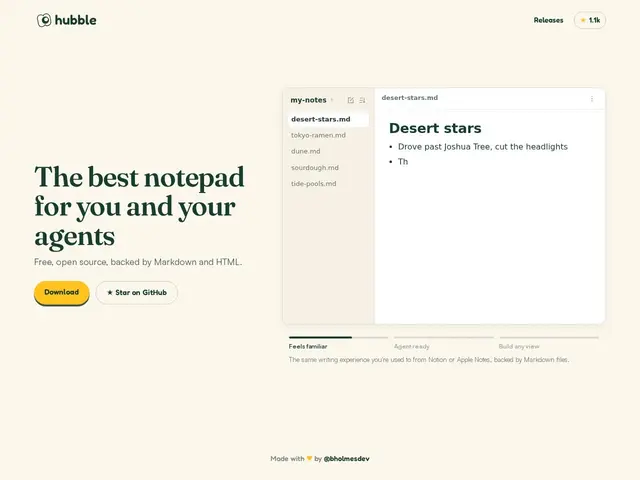
Description
Most note apps were designed for one kind of user: a human clicking around a UI. Hubble starts from a different assumption — that an AI agent might also need to read, search, and edit your notes directly — so it keeps everything as plain markdown files on disk (readable and editable by any tool, including an AI agent working through your file system) while still giving you a proper writing experience on top, not just a bare text editor.
It's fully open-source under the MIT license, with 680+ commits showing active development, and runs both as a web app and as a desktop client via Electron for local-first use. Because notes are markdown rather than locked in a proprietary format, there's no vendor lock-in — you can always read your files with any other tool. It also supports custom "skills," an extensible way to build domain-specific views on top of your notes rather than being stuck with one fixed layout. There's no commercial tier or paid plan; it's community-maintained software, free to use and self-host.
💬 Our review
The short version: Hubble is a thoughtfully-designed bet on a specific near-future — note-taking where AI agents are first-class collaborators, not just a chat window bolted on the side — and building on plain markdown files rather than a proprietary format is exactly the right call for that bet.
Against Obsidian, the closest comparison in spirit (also markdown-based, also extensible), Obsidian has years of plugin ecosystem maturity and a much larger community that Hubble simply doesn't have yet. Against Notion, which is cloud-native and proprietary, Hubble's markdown-first, local-first, open-source approach is the more developer-aligned choice if you want your notes portable and inspectable by any tool — including your own scripts. The trade-off is exactly what you'd expect from an early open-source project: fewer integrations, a smaller ecosystem, and entirely community-driven maintenance with no commercial support to fall back on. For someone already living in an agent-heavy workflow who wants their notes directly accessible to that agent, Hubble is a genuinely interesting pick; for someone who just wants the most polished, plugin-rich note app today, Obsidian remains the safer bet.
💰 Pricing
📊 Global score
🤖 AI-enriched data
Gratuit et open-source (licence MIT), auto-hébergeable. Aucun palier commercial ni support payant.
Pros
Fichiers markdown natifs, aucun format propriétaire, aucun verrouillage fournisseur
Conçu explicitement pour la collaboration avec des agents IA via accès système de fichiers
Gratuit, open-source (MIT), déploiement web + desktop (Electron)
Cons
Écosystème de plugins/intégrations bien plus restreint qu'Obsidian
Projet encore jeune, fonctionnalités en évolution
Aucun support commercial, maintenance entièrement communautaire