ContextVault
A shared memory layer that keeps context consistent across Claude, ChatGPT, Copilot and other AI tools, so you and your team stop re-explaining the same things to every new AI session.
🔗 Visit ContextVault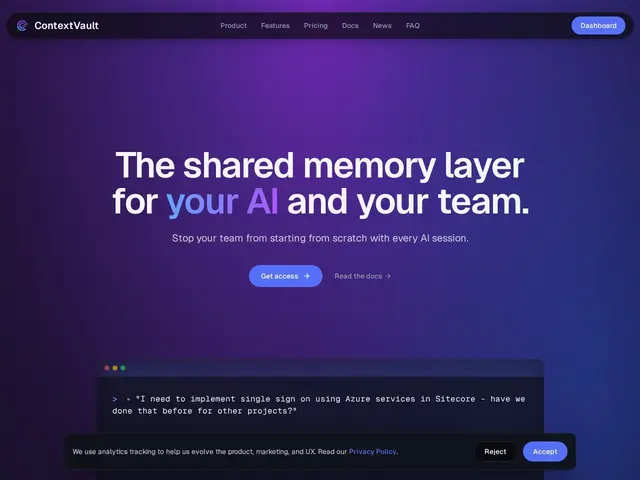
Description
If you use more than one AI assistant — Claude for coding, ChatGPT for research, Copilot in your editor — you've probably noticed each one starts from zero every time. You explain your project's conventions to Claude on Monday, then explain the same thing to ChatGPT on Tuesday, and neither remembers what the other learned. Multiply that across a whole team and you're re-explaining the same architecture decisions and past mistakes constantly, because nothing is actually shared. ContextVault is a memory layer that sits underneath all your AI tools — Claude, ChatGPT, Copilot, Ollama and others — so a fact learned in one conversation stays available in every other one, for you and for your teammates.
Technically, ContextVault stores memories centrally and serves them to any MCP-compatible client through hybrid retrieval that combines vector search and full-text search, so recall works whether a query is semantic or an exact keyword match. Memories carry user, group and organization-level scoping with audit trails, so a company can share institutional knowledge broadly while keeping sensitive project context restricted to the right team. Pricing is freemium: a free 7-day trial (1 seat, 50 memories), Solo at $9.99/month, Team at $49.99/month for 10 seats, and custom Enterprise plans.
💬 Our review
The short version: if your team juggles multiple AI coding assistants and keeps losing context between them, ContextVault solves a real and growing annoyance — a durable, shared memory instead of five separate amnesiac chatbots.
The category is crowded and moving fast right now (this same idea — persistent, cross-client AI memory — is being built by several teams in parallel, and model vendors themselves are creeping toward native memory features), so the honest question is whether a dedicated third-party tool stays necessary once the model vendors ship this broadly. ContextVault's edge is being vendor-neutral and MCP-based, meaning it works the same way across Claude, ChatGPT and Copilot rather than locking you into one ecosystem, and the org/group scoping is aimed squarely at teams rather than individual hobbyists. At $49.99/month for a 10-seat team, it's cheap enough to try, but check the 500-2,500 memory caps on the Solo/Team tiers before committing if your team generates a lot of context daily.
💰 Pricing
📊 Global score
🤖 AI-enriched data
Essai gratuit 7 jours (1 siège, 50 mémoires), Solo 9,99$/mois (1 siège, 500 mémoires), Team 49,99$/mois (10 sièges, 2500 mémoires), Enterprise sur devis
Pros
Compatible MCP, fonctionne avec Claude, ChatGPT, Copilot, Ollama
Recherche hybride vectorielle + plein texte
Scoping utilisateur/groupe/organisation avec piste d'audit
Essai gratuit sans carte
Cons
Catégorie très concurrentielle, les éditeurs IA ajoutent leur propre mémoire native
Plafonds de mémoires assez bas sur Solo/Team (500-2500)
Encore en bêta privée, maturité à confirmer