Kedge
A cloud hosting platform where your app runs in its own tiny virtual computer that can be instantly copied — so testing a risky change or spinning up a preview for a teammate takes seconds, not a whole new deployment.
🔗 Visit Kedge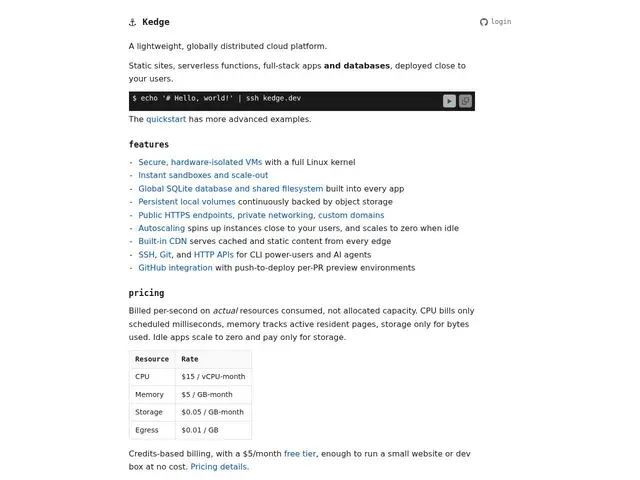
Description
Most cloud platforms make you choose between simple static hosting (fast but limited) and full virtual machines (flexible but slow to spin up and manage). Kedge tries to give you both: you deploy a real, full Linux environment — capable of running a database, a backend, anything you'd run on a VPS — but it starts in seconds, can be forked (snapshotted and copied) instantly for a preview branch or a test, and scales down to zero when nobody's using it so you're not paying for idle time.
Technically, Kedge runs hardware-isolated VMs with full Linux kernels, gives every app a global SQLite database built in, and provides a shared filesystem backed by object storage for persistence. It handles public HTTPS endpoints, private networking, custom domains, autoscaling that places instances near users, and a built-in CDN, and you can deploy via SSH, Git, HTTP APIs, or GitHub integration (including automatic preview environments per PR). Pricing is usage-based and billed per second: roughly $15 per vCPU-month, $5 per GB-month of memory, $0.05 per GB-month of storage, and $0.01 per GB of egress, with a free tier including $5/month in credits.
💬 Our review
The short version: if you like the idea of Vercel-style instant deploys but need a real server underneath (a database, background jobs, anything that doesn't fit serverless functions), Kedge's forkable-VM model is a genuinely useful middle ground.
Compared to Fly.io or Railway, which also offer fast full-VM deployments, Kedge's headline feature — instantly forking a running VM as a snapshot, plus a built-in global SQLite layer — is a more distinctive angle than most competitors offer out of the box; whether that's worth switching depends on how much you'd actually use snapshot-forking versus just wanting reliable, cheap compute. Against pure serverless platforms (Vercel, Cloudflare Workers), Kedge trades some of that zero-ops simplicity for full VM flexibility, which matters if your app needs persistent processes or isn't a good serverless fit. As a newer, smaller platform without an established track record at scale, it's a reasonable bet for side projects and small production apps, but probably not yet the safe choice for a large team betting its core infrastructure on it.
💰 Pricing
📊 Global score
🤖 AI-enriched data
~15$/vCPU-mois, 5$/Go-mois mémoire, 0.05$/Go-mois stockage, 0.01$/Go sortie ; palier gratuit avec 5$/mois de crédits
Pros
VM forkable instantanément (snapshot) pour previews/tests
SQLite global intégré à l'application
Scale-to-zero, facturation à la seconde
Preview environments automatiques par PR GitHub
Cons
Plateforme jeune, pas de bilan de fiabilité à grande échelle établi
Moins de simplicité "zéro-ops" qu'un serverless pur (Vercel/Cloudflare Workers)
Date de fondation non trouvée publiquement