OpenKnowledge
A notes app like Obsidian or Notion, but built so an AI coding assistant can read and edit your documents directly — useful for teams who keep specs, runbooks, or project docs that both humans and AI agents need to work from.
🔗 Visit OpenKnowledge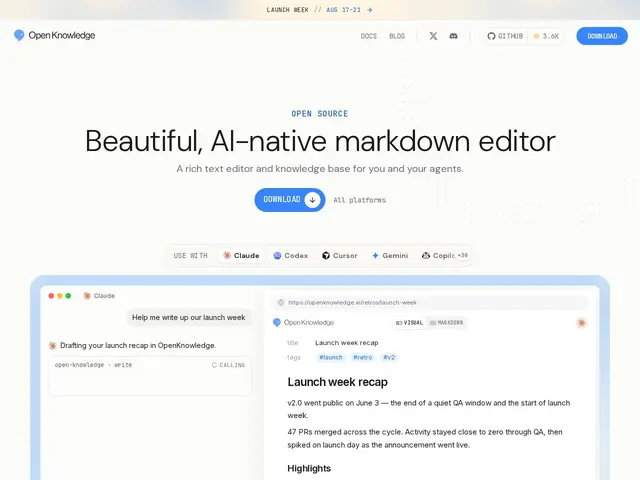
Description
Most note-taking apps were built for humans typing into them, and bolting AI on afterward tends to feel like an add-on rather than something the tool was designed around. OpenKnowledge takes the opposite approach: it's a knowledge base built from the start so that AI agents like Claude, Cursor, and Codex can read and write your documents natively, alongside a normal what-you-see-is-what-you-get editing experience for humans.
Technically it supports the Model Context Protocol (MCP), meaning coding agents can query and update your knowledge base as a first-class integration rather than through screen-scraping or copy-paste. It includes rich document components — callouts, accordions, tabs, Mermaid diagrams, embedded media — Git-backed sync for version control and team collaboration without depending on a cloud vendor, agentic search over your notes using embeddings and retrieval (RAG), and one-click sharing. It's fully open-source under GPL-3.0+, distributed as a macOS desktop app plus a web UI (which needs Node.js 24+ to self-host), with over 3,000 GitHub stars. There's no commercial cloud subscription — it's free, self-hosted or run locally.
💬 Our review
The short version: if your team already treats AI agents as co-authors of your documentation — specs, incident runbooks, living docs an agent edits alongside a human — OpenKnowledge's native MCP integration is a real, structural advantage that bolt-on AI features in Obsidian or Notion don't match.
Against Obsidian, which is local-first and plugin-extensible but has no native AI-agent integration, OpenKnowledge wins specifically on agent workflows and loses on ecosystem maturity — Obsidian's plugin library dwarfs anything OpenKnowledge currently offers. Against Notion, which is a polished commercial product with basic AI features bolted on, OpenKnowledge is fully open-source and self-hosted (no vendor lock-in, no monthly bill) but requires real technical setup — Node.js 24+ for the web UI is a genuine barrier for non-technical teams. Worth it specifically for engineering teams building agent-integrated documentation workflows; if you just want a nice personal notes app, Obsidian's ecosystem and polish still win.
💰 Pricing
📊 Global score
🤖 AI-enriched data
Licence GPL-3.0+, aucun abonnement cloud commercial. Auto-hébergement (app macOS ou UI web, Node.js 24+ requis)
Pros
Intégration MCP native : les agents IA lisent/écrivent directement les documents
Entièrement open-source (GPL-3.0+), plus de 3000 étoiles GitHub
Synchronisation Git pour versionner et collaborer sans dépendre d'un cloud propriétaire
Recherche agentique via RAG et embeddings, pas juste mots-clés
Cons
Aucune offre cloud commerciale, auto-hébergement requis (barrière technique)
UI web nécessite Node.js 24+, friction pour équipes non techniques
Écosystème de plugins/intégrations plus restreint qu'Obsidian ou Notion
App desktop centrée macOS, Windows/Linux via UI web uniquement