InPrivy
A way to send a password or API key to someone without leaving it sitting in an email or chat forever — you get a link that self-destructs after it's opened once.
🔗 Visit InPrivy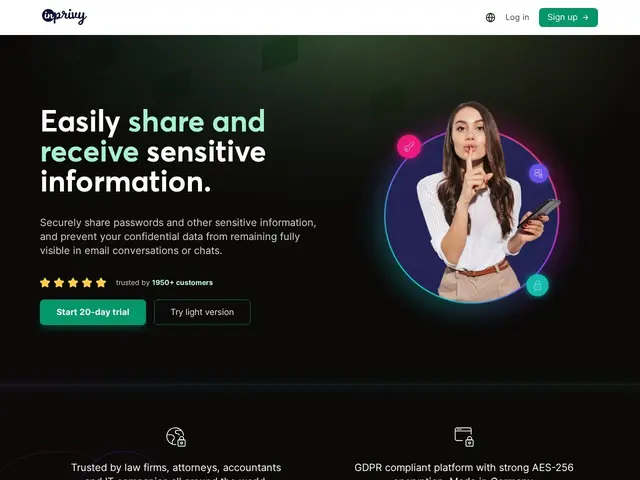
Description
Sending a password, API key or credit card number by email or Slack means it sits there in plain text, in your sent folder and theirs, indefinitely. InPrivy replaces that habit with a link: you paste the sensitive data in, InPrivy encrypts it, and it generates a one-time link that destroys the content the moment it's opened (or after a set time). Nothing sensitive lingers in an inbox to be found later in a breach.
InPrivy is an AES-256-encrypted secure sharing tool aimed at law firms, accountants, IT companies and teams needing GDPR-compliant exchange of sensitive information. It supports customizable one-time-use links, file attachments up to 30 GB depending on plan, custom branding and domains, an API for programmatic secret management, notifications when a secret is opened, and 45-90 day history logs. Unlike most competitors in this space, it's sold as a one-time lifetime license (€49 Solo, €129 Business) rather than a subscription, and it's positioned as ISO 27001 certified with servers based in Germany — relevant for teams specifically needing EU data residency.
💬 Our review
The short version: if you're a law firm, accountant or small IT team in the EU that regularly needs to send passwords or sensitive files and cares about GDPR and data residency, InPrivy's one-time-license model plus EU hosting is a genuinely differentiated pitch against subscription-based competitors.
It competes with OneTimeSecret, PrivateBin and Password Pusher, all of which do the same core job (self-destructing secret links) — some of them free and open-source. InPrivy's edge is the professional feature set (branding, API, audit logs, ISO 27001, German servers) bundled into a one-time payment instead of a recurring subscription, which is unusual and can pay for itself fast for regular use. The tradeoff is that free alternatives like PrivateBin or Password Pusher's free tier cover the basic case perfectly well if you don't need branding, audit trails or EU-specific compliance — so the value here is concentrated in regulated, professional-services use cases rather than casual one-off secret sharing.
💰 Pricing
📊 Global score
🤖 AI-enriched data
Solo €49 (1 espace de travail, 10 Go) · Business €129 (3 espaces, 30 Go) · essai gratuit 20 jours, pas d'abonnement
Pros
Chiffrement AES-256 avec liens à usage unique auto-destructibles
Paiement unique à vie plutôt qu'un abonnement récurrent
Certifié ISO 27001, serveurs en Allemagne (résidence des données UE)
API pour gestion programmatique des secrets, marque blanche disponible
Cons
Alternatives gratuites (PrivateBin, Password Pusher) couvrent déjà le cas d'usage basique
Page de tarification dédiée introuvable (404), infos uniquement sur la homepage
Moins pertinent pour un partage ponctuel occasionnel hors contexte pro/réglementé
Peu de notoriété comparé aux concurrents établis