StatusStack
When AWS, Stripe or GitHub goes down, StatusStack tells you before your customers do — it watches over 10,900 third-party services you depend on and pings your team the moment one has a problem, instead of you finding out from an angry support ticket.
🔗 Visit StatusStack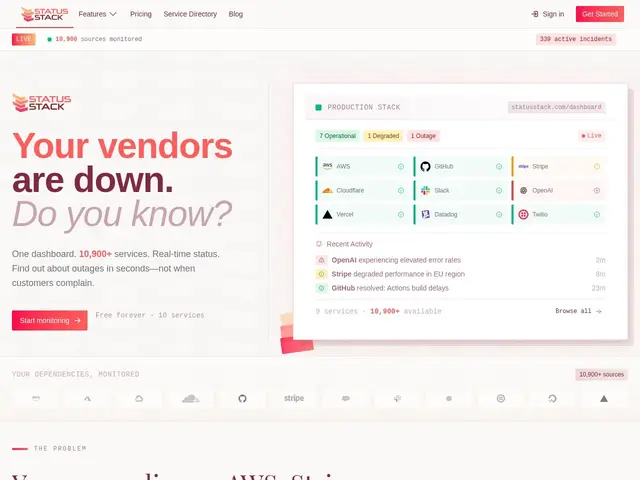
Description
Modern products depend on dozens of third-party services — a payment processor, a cloud host, an auth provider, a CDN — and when any one of them has an outage, it can break your product even though the bug isn't yours. Most teams find out the hard way: a spike in support tickets. StatusStack's answer is to watch the status of those dependencies for you and alert your team the moment something breaks, before customers notice.
StatusStack tracks over 10,900 vendor services (AWS, Azure, Stripe, Salesforce, GitHub and more), polling every 60 seconds, with instant alerts across Slack, Teams, email, webhooks, Discord and Telegram. It provides a unified, customizable dashboard, team collaboration with role-based access, full incident history and analytics, and a REST API for programmatic access. Pricing runs from a free tier (10 services, 7-day history) through Pro at $49/month (50 services, unlimited history) to custom Enterprise for unlimited services and custom source monitoring.
💬 Our review
The short version: any team whose product depends on multiple third-party APIs or cloud services should have something watching those dependencies, and StatusStack's broad 10,900-service coverage plus multi-channel alerting makes it a solid, low-effort way to do that.
Against StatusGator (a similarly broad status-aggregation tool, longer track record) or building your own polling script against public status pages (free but fragile and unmaintained), StatusStack's edge is breadth of coverage and polished alerting/dashboard/API out of the box. The free tier's 10-service cap will feel tight fast for any team with a real stack, pushing most serious users to the $49/month Pro tier, which is reasonable for the visibility gained but adds up alongside other monitoring tools (uptime monitors, APM) a team may already pay for. Worth it for teams that want a single pane of glass over third-party dependency health without building it themselves; teams already paying for a broader observability platform (Datadog, etc.) should check whether it already covers vendor status before adding another tool.
💰 Pricing
📊 Global score
🤖 AI-enriched data
Gratuit (10 services, historique 7 jours), Pro 49$/mois ou 41$/mois annuel (50 services, historique illimité), Enterprise sur devis
Pros
Couverture large : plus de 10 900 services tiers surveillés
Alertes multi-canal (Slack, Teams, email, webhooks, Discord, Telegram)
Sondage toutes les 60 secondes — détection rapide des incidents
API REST pour intégration programmatique
Cons
Palier gratuit limité à 10 services — insuffisant pour une stack réelle
Coût qui s'ajoute à d'autres outils de monitoring déjà en place (APM, uptime)
Moins de recul que StatusGator, acteur plus ancien du secteur
Fonction de sources personnalisées réservée à l'Enterprise