AgentMemory
A local notebook for AI coding assistants like Claude Code or Cursor, so they remember what happened in yesterday's session instead of starting from a blank page every time you open a new chat.
🔗 Visit AgentMemory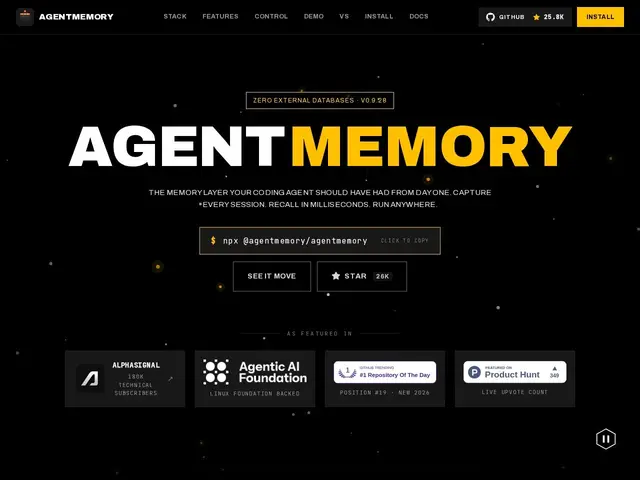
Description
AI coding assistants are famously forgetful — close the chat window and everything the assistant learned about your codebase, your preferences, and what you already tried is gone. Re-explaining context every session wastes time and tokens. AgentMemory works like a running lab notebook that the assistant writes to automatically as it works, and reads from the next time it starts, so it remembers what it already figured out instead of re-deriving it from scratch.
Technically, it's a persistent memory runtime that hooks into coding agents via 12 auto-capture hooks, compresses raw session transcripts into structured memories on an hourly sweep, and retrieves relevant context through a "triple-stream" search combining BM25 keyword matching, vector similarity, and knowledge-graph queries. It runs as a single Node.js process with zero external database dependencies, exposes 53 MCP tools and 128 REST endpoints, and claims sub-20ms retrieval latency with a 92% reduction in tokens spent re-establishing context, at 95.2% retrieval accuracy in its own benchmarks. It's Apache-2.0 licensed and free.
💬 Our review
The short version: if you're burning tokens every session re-explaining your codebase to Claude Code or Cursor, AgentMemory is free and local, so there's little reason not to try it — just treat its own accuracy numbers as a starting point, not a guarantee, since they're self-reported.
Against Mem0 or LettaAI, both cloud-hosted memory services with their own pricing tiers, AgentMemory's pitch is running entirely locally with zero external database — appealing if you don't want session data leaving your machine, less appealing if you wanted a managed service with someone else handling uptime. Against just relying on Claude Code's or Cursor's built-in context handling, the honest case for AgentMemory is cross-session persistence and semantic search across weeks of history, which built-in context windows don't give you. The catch: it's a young, single-maintainer-scale project (agent-memory.dev, not a company you'll find much about independently), so the pitch to weigh is whether a local memory layer with fewer track-record signals is worth trusting with the exact context your agent will act on.
📊 Global score
🤖 AI-enriched data
Apache-2.0, entièrement gratuit, tourne en local sans base de données externe requise.
Pros
Gratuit et open source
100% local, zéro dépendance base de données externe
Recherche hybride triple-stream (BM25 + vecteurs + graphe)
Faible latence de récupération revendiquée
Cons
Chiffres de performance auto-rapportés, non vérifiés indépendamment
Projet jeune sans société ni antécédents publics
Pas de synchronisation multi-appareils native
Configuration par agent requise, pas zéro-config