Bounce
A free, decentralized group chat app that hides not just your messages but who's talking to whom, by routing everything through the Tor network.
🔗 Visit Bounce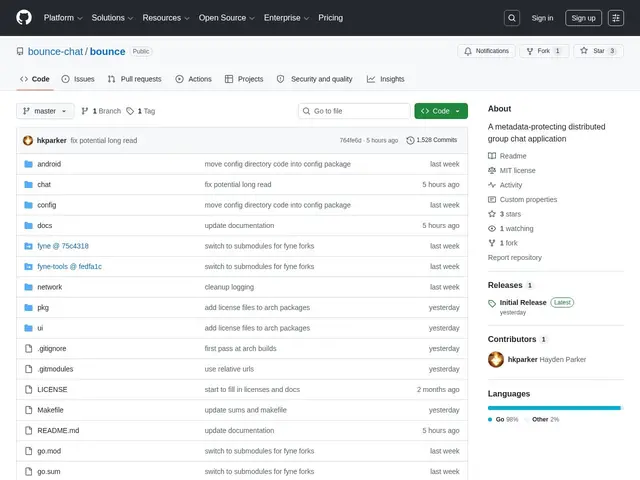
Description
Most encrypted chat apps protect what you say but still reveal metadata — who's talking to whom, when, and how often — to the company running the service. Bounce is built to close that gap for group chats: it has no central server at all, and it routes every connection between devices through the Tor network specifically to make that metadata as hard to observe as the message content itself.
It's a free, open-source (MIT) application written in Go with a Fyne-based interface, supporting multi-device use with per-device encryption. It's available on Linux, macOS, Windows, and Android (no iOS support). The project is explicitly experimental and hasn't yet undergone a third-party security audit.
💬 Our review
The short version: if metadata protection for group communication is a real requirement for you — not just message content encryption — Bounce is an interesting free option to watch, but its unaudited, experimental status means it's not yet something to bet sensitive communication on.
Against Signal, the gold standard for encrypted messaging with a huge audited codebase and a centralized (but privacy-respecting) infrastructure, Bounce's decentralized, Tor-routed design is a more radical answer to metadata protection specifically, at the cost of Signal's maturity, polish, and security track record. Against Briar, which shares similar decentralized, censorship-resistant goals, Bounce is comparably early-stage. Reported weak performance on Android and the complete absence of a third-party security audit are the two biggest reasons to treat this as promising research software rather than a production-ready replacement for Signal today.
📊 Global score
🤖 AI-enriched data
Gratuit et open source (licence MIT).
Pros
Protection complète des métadonnées via Tor
Architecture décentralisée
Support multi-appareil
Logiciel libre auditable
Multi-OS + Android
Cons
Projet expérimental sans audit tiers
Pas de support iOS
Performances faibles sur Android
Adoption réduite