Spawned
Cloud platform enabling deployment of real infrastructure to AWS, GCP, or Azure with centralized provisioning, scaling, and operations management.
🔗 Visit Spawned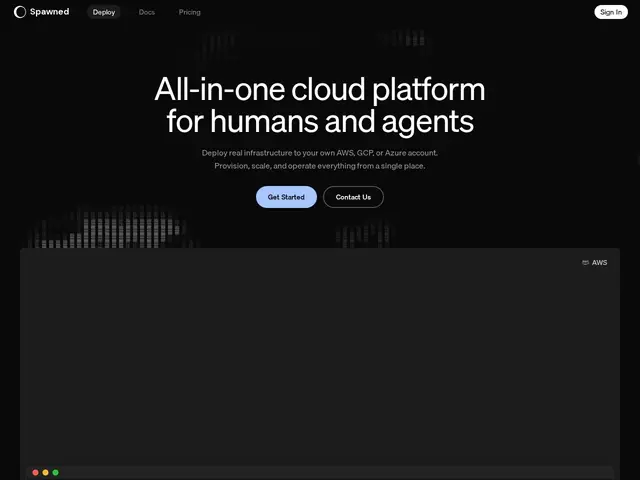
Description
Serverless platforms like Vercel are easy to use but lock your app into their infrastructure; running your own AWS or GCP setup gives full control but demands a DevOps team. Spawned aims for the middle: Vercel-like deployment simplicity, but onto infrastructure you actually own and can export at any time.
Spawned is a multi-cloud deployment platform provisioning and managing real infrastructure on AWS, GCP, or Azure, with Terraform-compatible, exportable infrastructure and a unified dashboard for deployments, logs, and policies. Pricing is usage-based, tied to actual cloud resource consumption, with $20/month in complimentary compute credits for new users.
💬 Our review
The short version: Spawned's "Vercel for your own cloud" pitch is credible — the exportable, Terraform-compatible infrastructure genuinely avoids the vendor lock-in that makes Vercel or Heroku uncomfortable for larger, longer-term projects.
Against Vercel, which is simpler but locks you into its platform, and Heroku, which is easy but increasingly expensive at scale, Spawned trades some of that simplicity for real ownership of your infrastructure across AWS, GCP, or Azure. Usage-based pricing means costs scale with actual resources rather than a flat tier, which is fairer but less predictable — worth watching closely if budget certainty matters to you.
📊 Global score
🤖 AI-enriched data
Usage-based pricing tied to actual cloud resources (compute, storage, bandwidth). $20/month complimentary compute credits for new users. No tiered structure specified.
Pros
Multi-cloud deployment to AWS, GCP, Azure avoids vendor lock-in
Terraform-compatible, exportable infrastructure
Unified operational dashboard for deployments, environments, logs, policies
Enterprise-grade security defaults and declarative infrastructure
Cons
Usage-based pricing may be unpredictable for cost-conscious teams
Requires AWS/GCP/Azure accounts; adds operational complexity
No mention of managed databases or advanced observability beyond basic logs