OpenStatus
An open-source tool that watches whether your website is up and automatically publishes a public status page telling your users when something breaks.
🔗 Visit OpenStatus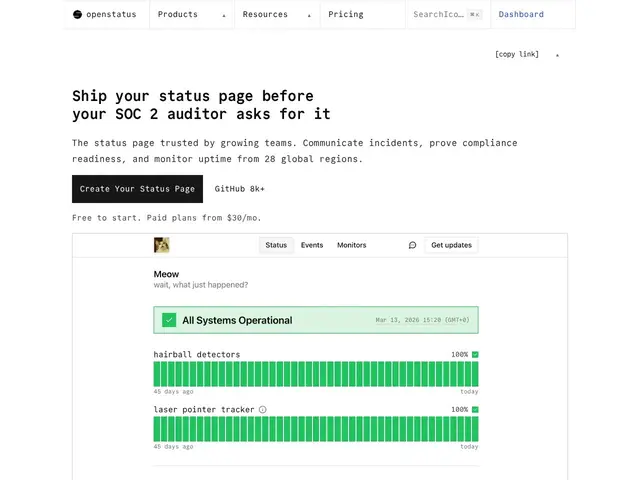
Description
When a website goes down, customers usually find out the hard way — by hitting an error — unless a company has a status page to tell them what's happening. OpenStatus checks your site or API on a schedule from multiple locations around the world, and if something's wrong it can automatically post an update to a public status page and alert your team, so users get answers instead of confusion.
OpenStatus is an open-source uptime monitoring and status page tool that checks endpoints from 28 global regions across 3 cloud providers, sends incident alerts via Slack, Discord, PagerDuty, email, or webhooks, and generates audit-ready incident documentation with timestamps for compliance purposes like SOC 2. It's self-hostable as an 8.5MB Docker image, or usable as a hosted service, and is manageable programmatically via CLI, API, Terraform, or an MCP server. The free plan covers 1 monitor and 1 status page with 3 components at 10-minute check intervals; paid plans start at $30/month ($25/month billed annually) for more monitors, faster checks, and custom domains.
💬 Our review
The short version: OpenStatus is a solid, developer-friendly status page and monitoring tool, especially attractive because it's open-source and self-hostable if you don't want to depend on a third-party SaaS for something as sensitive as your own outage reporting.
The self-hosting option is the real differentiator versus Atlassian Statuspage or Incident.io — an 8.5MB Docker image is genuinely lightweight to run yourself, and the CLI/Terraform/MCP tooling suggests a team that understands developer workflows rather than just building a marketing-facing dashboard. The honest limitation is the free tier: one monitor and one status page with 10-minute check intervals is really a trial, not something a real production service could rely on, so most teams will end up on the $30/month plan quickly. Compared to the market leader Atlassian Statuspage, OpenStatus is considerably cheaper and more transparent about self-hosting, but has less enterprise polish and integration depth — a good fit for a startup or small engineering team, less so for a large org already deep in the Atlassian ecosystem.
📊 Global score
🤖 AI-enriched data
Gratuit : 1 moniteur, 1 page de statut, 3 composants, vérifications toutes les 10 min. Payant à partir de 30$/mois (25$/mois en facturation annuelle).
Pros
Open-source et auto-hébergeable (image Docker de 8,5 Mo)
Surveillance depuis 28 régions sur 3 fournisseurs cloud
Documentation d'incident prête pour un audit SOC 2
Pilotable en CLI, API, Terraform et serveur MCP
Cons
Palier gratuit très limité : un seul moniteur et une seule page de statut
Intervalle de vérification gratuit plafonné à 10 minutes
Moins de profondeur d'intégration entreprise que les leaders établis