Overslash
A middleman that sits between your AI agents and the online services they need to use (GitHub, Slack, AWS, and more), so the agent can act on your behalf without ever seeing your actual passwords or API keys.
🔗 Visit Overslash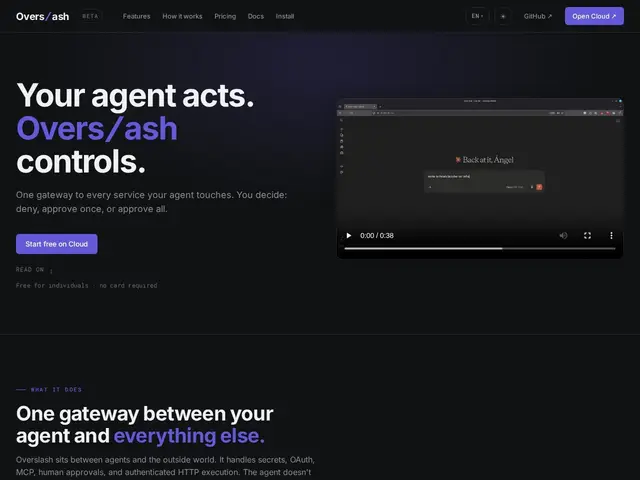
Description
Giving an AI agent access to your GitHub account or Slack workspace usually means handing it an API key or token directly, which it then holds in its own memory or context — a real risk if that context ever leaks or the agent misbehaves. Overslash is built to remove that risk: it holds the credentials on your behalf, and the agent asks Overslash to make the call instead of making it directly.
Overslash acts as an authentication and action gateway between AI agents and the outside world, supporting GitHub, Slack, AWS, Google Workspace, Notion, Linear, Vercel, PostgreSQL, and any HTTP API. It manages OAuth flows and secrets in a vault the agent never directly sees, offers configurable human-approval gates (deny, approve once, or approve all future calls of that type), and keeps a searchable, exportable, streaming audit log of every call an agent makes and every approval decision. It's natively aligned with the Model Context Protocol (MCP), the same standard Claude and other assistants use to connect to tools. The self-hosted version is free and open-source (MIT/Elastic 2.0 licensed) with unlimited agents and integrations; a hosted Cloud version has a free personal tier and a €3/month per-seat team tier with SSO and shared credentials.
💬 Our review
The short version: if you're running AI agents that touch real accounts — GitHub repos, Slack workspaces, cloud infrastructure — Overslash's free self-hosted tier is a low-cost way to stop handing raw credentials to an agent's context window, and it's worth adopting before you scale up agent usage, not after something goes wrong.
Against the simplest alternative — just giving an agent an API key directly — Overslash's value is entirely in the audit trail and approval gates: you can see exactly what an agent did and stop it before it does something risky, rather than finding out after the fact. Against broader identity platforms like Auth0 for AI Agents or Cloudflare's AI Gateway, Overslash is narrower and more specifically built around the MCP/agent workflow, which makes it simpler to adopt if that's your exact use case but less of a fit if you need broader identity management beyond agents. The main caution: it's a beta-stage product with no public launch date and a 404 pricing page at the time of review, so treat the pricing details as subject to change and expect some rough edges. For individual developers and small teams already using MCP-connected agents, the free self-hosted tier is close to risk-free to try.
💰 Pricing
📊 Global score
🤖 AI-enriched data
Self-hosted : gratuit (licence MIT/Elastic 2.0), agents et intégrations illimités. Cloud personnel : gratuit à vie. Cloud équipe : 3€/mois par siège, credentials partagés, dépassements facturés à l'usage.
Pros
Les secrets ne touchent jamais le contexte de l'agent
Portes d'approbation humaine configurables (refuser/approuver une fois/approuver tout)
Journal d'audit recherchable et exportable de chaque appel
Intégration native MCP, alignée sur l'écosystème Claude
Version self-hosted gratuite et open source, agents illimités
Cons
Produit en beta, pas de date de lancement publique
Page de tarification renvoyait une 404 au moment de l'audit
Plus étroit que des plateformes d'identité généralistes (Auth0, Cloudflare)
Écosystème encore jeune, peu de retours d'expérience en production