FlickNote
An app that turns a quick voice memo, a forwarded link, or a rambling meeting recording into a clean, searchable note — without you having to type or organize anything.
🔗 Visit FlickNote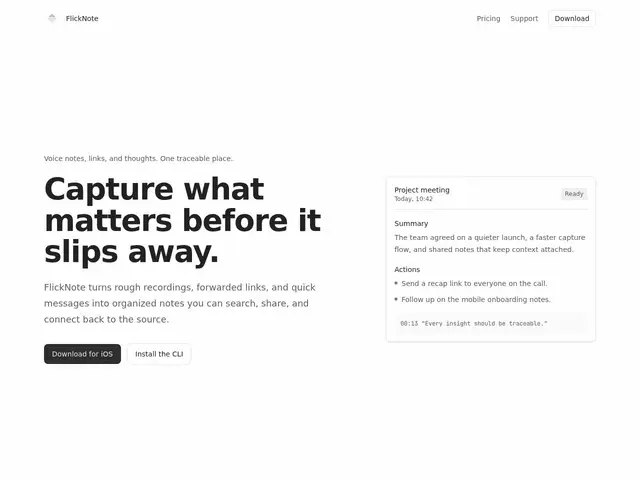
Description
Most people's best ideas happen when they're not in front of a keyboard — walking, driving, in a meeting — and by the time they sit down to write it up, half of it is gone. FlickNote is built around that gap: you talk, forward a link, or drop a message into it, and it automatically transcribes, organizes, and files the result into a searchable note, keeping a trace back to exactly when and where it came from.
FlickNote is a mobile-first (iOS) voice-notes app that also pulls in links and messages from other work tools, turning scattered input into one searchable archive with timestamps and source references. It's aimed at people who capture a lot of loose information during the day — meetings, quick thoughts, articles worth remembering — and want it organized without manual filing. It also ships a CLI, explicitly positioned for integration with AI coding agents like Claude Code and Codex, letting developers pipe notes or context into their agent workflows. Pricing is credit-based ("Neurons"): a free tier with 20 Neurons and 100 MB of storage, a Plus plan at $5.99/month (or $59.99/year) with 400 Neurons and 50 GB, and a Pro plan at $11.99/month (or $119.99/year) with 1,200 Neurons and 100 GB; additional Neuron packs can be bought separately, and Pro includes a two-week free trial.
💬 Our review
The short version: if you generate a lot of voice memos, meeting recordings, or forwarded links you never get around to organizing, FlickNote's low-friction capture-and-search loop is genuinely useful and cheap enough to try risk-free on the free tier.
The standout detail is the CLI aimed at AI coding agents — most consumer note apps don't think about developer workflows at all, so if you're already living inside Claude Code or Codex sessions, being able to pipe notes directly into that context is a real differentiator over mainstream note apps like Notion or Apple Notes. The credit-based ("Neurons") pricing model is a little unusual for a note-taking app and worth understanding before you commit — it ties your usable storage and transcription volume to a consumable resource rather than a flat monthly allowance, so heavy users should check whether $5.99–$11.99/month realistically covers their volume before relying on it daily. No competitor comparison is published on the site, and it's a young product (2026), so expect some rough edges. Good fit for people with a habit of voice-memoing ideas on the go, or developers wanting notes wired into their AI agent workflow; less compelling if you already have a note system you're happy with and don't need voice capture specifically.
💰 Pricing
📊 Global score
🤖 AI-enriched data
Gratuit : 20 Neurons, 100 Mo. Plus : 5,99 $/mois (400 Neurons, 50 Go). Pro : 11,99 $/mois (1 200 Neurons, 100 Go), essai gratuit 2 semaines.
Pros
Capture vocale sans friction, transcription automatique
CLI pensé pour s'intégrer à des agents IA (Claude Code, Codex)
Traçabilité des notes jusqu'à la source (horodatage, résumé)
Essai gratuit généreux pour tester sérieusement
Cons
Modèle de tarification par crédits, moins lisible qu'un forfait simple
Produit jeune (2026), quelques aspérités probables
Aucune comparaison concurrentielle publiée par l'éditeur
iOS uniquement pour l'app mobile (pas Android confirmé)