Secs-man
A tiny command-line tool for backing up SSH keys and other secrets so securely encrypted that you could still recover them in 10 years using nothing but standard Unix tools — even if this tool itself is long gone.
🔗 Visit Secs-man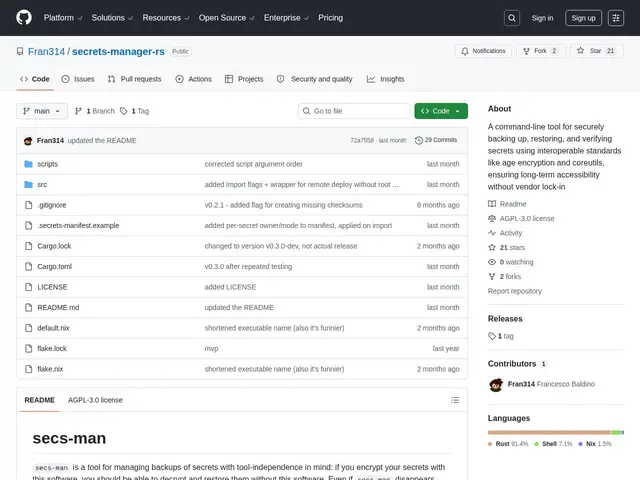
Description
Most secrets managers ask you to trust a company or a piece of software forever: your encrypted vault is only as recoverable as that specific tool staying maintained and available. Secs-man takes the opposite bet — it's a small command-line utility for backing up and restoring sensitive files like SSH keys or API tokens, built entirely around the idea that you should never be locked into it, because everything it produces can be decrypted using nothing but standard, decades-old Unix tools.
Secs-man is a free, open-source (AGPL-3.0) command-line tool written in Rust that uses the age encryption standard (with passphrase protection) plus SHA256 checksums for integrity verification. It supports exporting secrets with encryption, importing/restoring with proper file permissions, verifying an export's integrity at any time, and backing up to remote machines over SSH. Its core design philosophy is explicit: if secs-man disappeared tomorrow, anyone with a terminal, age, and coreutils could still manually recover the secrets — there's no proprietary format or vendor dependency hiding in the backup files.
💬 Our review
The short version: secs-man is for developers and sysadmins who specifically want to avoid vendor lock-in on their most sensitive backups — SSH keys, encryption identities, tokens — and are comfortable on the command line.
The tool-independence philosophy is the whole point, and it's executed well: building on age (a modern, well-regarded encryption tool) plus coreutils means the recovery path doesn't depend on secs-man surviving as a maintained project, which is a real and often-ignored risk with niche security tooling. SHA256 integrity verification and SSH-based remote backup cover the practical basics without over-engineering. The honest caveat: this is a small, single-purpose CLI tool from an individual developer, not a company-backed product — there's no GUI, no team-sharing features, no enterprise support, and you're trusting a young project's implementation of encryption correctly (always worth independent scrutiny for anything security-critical). If you need team secret-sharing or enterprise governance, this isn't that tool; if you want a minimal, transparent, lock-in-free way to back up your own keys, it does exactly what it says.
💰 Pricing
📊 Global score
🤖 AI-enriched data
Entièrement gratuit, licence AGPL-3.0.
Pros
Zéro vendor lock-in : récupérable avec juste age + coreutils
Chiffrement age + vérification d'intégrité SHA256
Sauvegarde à distance via SSH intégrée
Gratuit, open source, philosophie de transparence totale
Cons
Outil en ligne de commande uniquement, pas d'interface graphique
Projet individuel, pas de support entreprise
Pas de partage d'équipe ni de gouvernance multi-utilisateurs
Nécessite de faire confiance à l'implémentation d'un jeune projet pour du chiffrement critique