Powabase
Think of it as a Supabase for AI apps specifically — a database, a document-search engine, and a visual agent builder bundled together, so building an AI product doesn't mean separately wiring up Postgres, a vector store, and an orchestration framework yo
🔗 Visit Powabase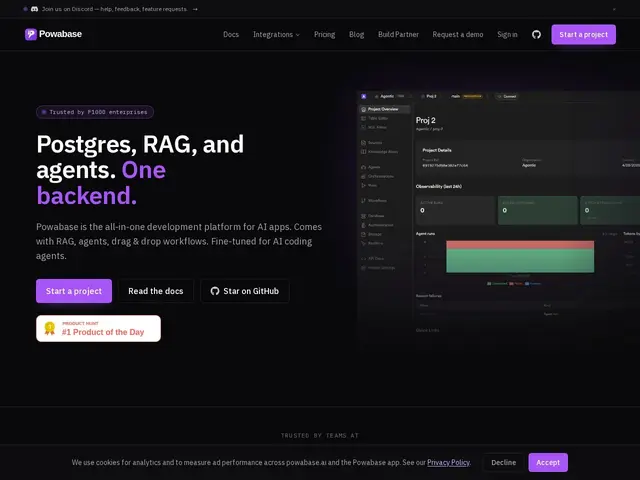
Description
Building an AI application usually means assembling several separate pieces — a database, a vector store for semantic search, document processing, and some kind of agent orchestration — and gluing them together yourself. Powabase's pitch is to be that assembly pre-wired, with an isolated Postgres database, a document RAG pipeline, and a visual workflow builder all in one platform.
Powabase offers an isolated PostgreSQL database per project with row-level security, a RAG pipeline with built-in OCR and multimodal document indexing (PDFs, images, office files, URLs), ReAct agent orchestration across multiple LLM providers, a visual DAG-based workflow builder with natural-language assistance, object storage with signed URLs and realtime subscriptions, and sub-100ms vector lookups via co-located retrieval and compute. It's open-source at the core (Apache-2.0, self-hostable via Docker Compose), designed to plug directly into AI coding agents like Claude Code, Cursor and GitHub Copilot with ready-to-paste connection strings in nine languages, and architected to be SOC 2 / ISO 27001 compliance-ready.
💬 Our review
The short version: Powabase's pitch is essentially "Supabase, but the missing pieces are RAG and agent orchestration instead of just auth and realtime" — a reasonable read of where AI-app backends are heading, and the open-source Apache-2.0 core with self-hosting removes the vendor-lock-in objection that would otherwise apply to a new backend-as-a-service.
Against rolling your own stack with Supabase + a separate vector database + LangChain-style orchestration, Powabase's advantage is fewer moving pieces and pre-wired integration (sub-100ms co-located vector lookups is a real latency win over stitching a separate vector DB into the pipeline). Against Supabase itself for a project that doesn't need RAG or agents, Powabase is unnecessary complexity — it's a narrower, AI-specific tool, not a general backend replacement. Public pricing isn't disclosed, which makes it hard to compare total cost against assembling the pieces yourself. Worth adopting for a genuinely AI-native product that needs document RAG and agent orchestration from day one; overkill if you just need a Postgres backend with auth, where plain Supabase remains the simpler, more proven choice.
💰 Pricing
📊 Global score
🤖 AI-enriched data
Cœur open source (Apache-2.0) auto-hébergeable via Docker Compose. Cloud managé et offre entreprise disponibles, tarifs non publics.
Pros
Cœur open source (Apache-2.0), auto-hébergeable, pas de lock-in forcé
RAG avec OCR et indexation multimodale intégrés, pas besoin d'assembler un pipeline séparé
Recherche vectorielle sub-100ms grâce au calcul co-localisé
Intégration directe pensée pour les agents de codage IA (Claude Code, Cursor, Copilot)
Cons
Tarification publique non disponible, comparaison de coût difficile
Overkill pour un projet qui n'a pas besoin de RAG ou d'agents
Moins éprouvé et moins connu que Supabase pour un usage backend généraliste
Date de fondation non communiquée