Headscale
Tailscale makes it painless to connect all your devices into a private network, but it runs through Tailscale's own servers — Headscale is the same idea with the control server running on your own machine instead, so no company sits in the middle.
🔗 Visit Headscale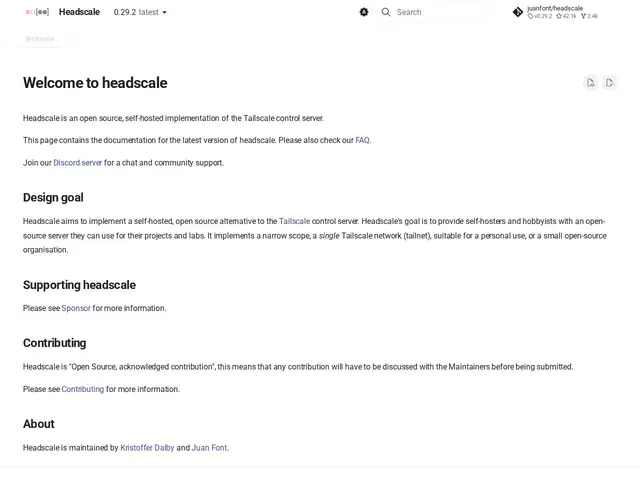
Description
Tailscale built a genuinely good product on top of WireGuard: connect your laptop, server and phone into one private network with almost no configuration. The catch is that the coordination server — the thing that introduces your devices to each other — is Tailscale's own commercial infrastructure, which some self-hosters and organizations would rather not depend on for anything from cost to data control.
Headscale is an open-source (BSD-3-Clause) reimplementation of that same control server, letting you run your own mesh VPN coordination plane while staying compatible with the official Tailscale client apps on Linux, macOS, Windows, iOS and Android. It handles node authentication, cryptographic key exchange, NAT traversal, route advertisement and IP assignment — everything the commercial control server does — and is written in Go, with 42,100+ GitHub stars, 2,400+ forks, and active development (4,394+ commits) including contribution from at least one Tailscale employee.
💬 Our review
The short version: Headscale's core value proposition is simple and well-proven — all of Tailscale's WireGuard-based mesh networking convenience, none of the dependency on Tailscale's commercial servers — and with 42,100+ GitHub stars it's one of the most battle-tested self-hosted networking projects available, not an experimental side project.
Against Tailscale itself, Headscale trades away the polished managed dashboard and official support for full control: no per-user pricing, no third party seeing your network topology, and the ability to run it entirely on your own infrastructure — a real win for privacy-conscious teams or anyone who just doesn't want a recurring VPN bill. Against other self-hosted mesh VPN options like plain WireGuard or Netmaker, Headscale's advantage is client compatibility: you use the same official Tailscale apps everyone already knows, just pointed at your own server. The tradeoff is that you're now responsible for running and updating that server yourself, and you lose Tailscale's official support and some enterprise features (like their managed ACL UI) that the commercial product includes. Worth it for any self-hoster or small org comfortable running one more Go binary who wants Tailscale's UX without the recurring cost or third-party dependency; stick with commercial Tailscale if you want zero maintenance and official enterprise support.
💰 Pricing
📊 Global score
🤖 AI-enriched data
Entièrement gratuit et open source (BSD-3-Clause), aucun coût, auto-hébergé.
Pros
Compatible avec les clients officiels Tailscale sur toutes les plateformes
Projet très mature et actif : 42 100+ étoiles GitHub, 4 394+ commits
Zéro dépendance à un fournisseur commercial, contrôle total des données réseau
Gratuit, sans limite d'utilisateurs ni facturation récurrente
Cons
Responsabilité de l'hébergement et de la maintenance du serveur reste à l'utilisateur
Pas de support officiel ni de certaines fonctionnalités enterprise de Tailscale (ex: UI ACL managée)
Demande des compétences self-hosting de base
82 issues ouvertes sur GitHub, projet actif mais avec du travail en cours