Gopher MCP
When you connect an AI agent to your company's tools through MCP (the protocol that lets Claude, Cursor and similar assistants call real APIs), you're opening a new door into your systems — and most teams have no way to watch what walks through it. Gopher
🔗 Visit Gopher MCP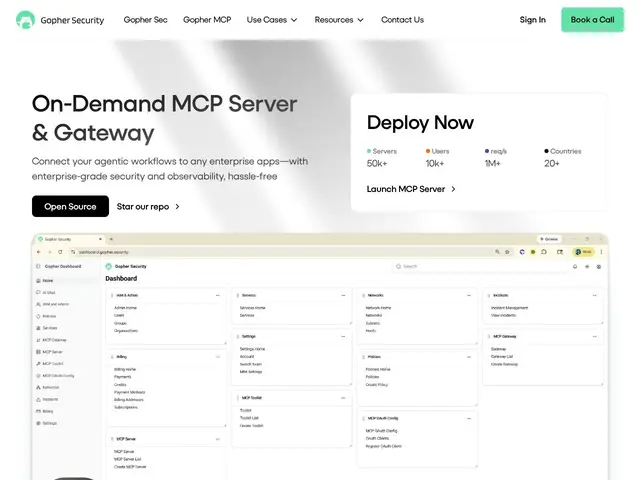
Description
As more teams let AI coding assistants and agents connect directly to internal tools via MCP, that connection becomes a new attack surface: a poisoned tool description or a prompt injection can trick an agent into leaking data or taking an unwanted action, and standard network security wasn't built with this in mind. Gopher MCP is a security layer built specifically for that problem.
Gopher inspects every MCP tool call in real time, blocking known attack patterns like tool poisoning, "puppet" attacks and prompt injection, and enforces zero-trust, context-aware access control down to the parameter level — so an agent can be allowed to read a table but blocked from deleting it, for example. It also encrypts P2P connections with post-quantum cryptography (aligned to FIPS 203/204), on the reasoning that data intercepted today could be decrypted by future quantum computers if today's encryption isn't upgraded. Deployment is described as taking minutes to hours, with centralized management across multiple environments and real-time audit logging. Pricing isn't published — the team offers custom quotes and a 30-day trial.
💬 Our review
The short version: if your team is exposing internal systems to AI agents through MCP, Gopher gives you an inspection and access-control layer built for that specific protocol, rather than trying to bolt traditional network security onto a problem it wasn't designed for.
Against general AI security platforms like Lineation (which governs agent identity and actions more broadly) or against doing nothing at all (still common for teams moving fast on MCP adoption), Gopher's differentiator is its protocol-level focus and the post-quantum encryption angle — a forward-looking bet that may matter more in a few years than today, but costs little to adopt now. The lack of public pricing is a real friction point if you're comparing options quickly; budget time for a sales conversation before you can judge fit. Worth evaluating seriously if you're already running MCP servers against production data; premature if you're still prototyping with a single local MCP server.
💰 Pricing
📊 Global score
🤖 AI-enriched data
Pas de tarification publique ; essai de 30 jours proposé, devis personnalisé selon la taille du déploiement.
Pros
Inspection en temps réel des tool calls MCP, détection tool poisoning / prompt injection
Contrôle d'accès zero-trust jusqu'au niveau du paramètre
Chiffrement post-quantique pour les connexions P2P
Déploiement annoncé en minutes à heures
Gestion centralisée multi-environnements
Cons
Tarification non publique — nécessite un contact commercial
Positionnement très spécifique (MCP), pas une solution de sécurité IA généraliste
Catégorie jeune, peu de retours d'expérience indépendants disponibles