OrgOrg
One app that bundles the small tools a growing team usually buys separately: calendars, feedback, recognition, on-call schedules and internal announcements.
🔗 Visit OrgOrg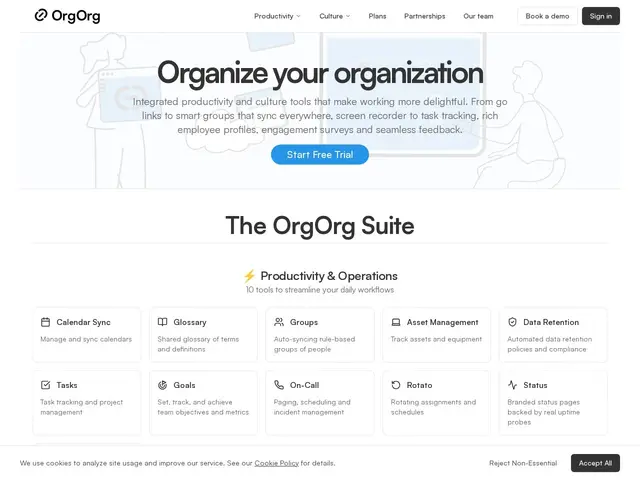
Description
Most small companies end up with a pile of separate apps just to run the basics of team life — one tool for on-call rotations, another for peer feedback, another for saying "happy work anniversary" to someone, another for tracking who's out sick. OrgOrg tries to replace that whole pile with a single app so a 15-person startup doesn't have to pay for and juggle six different subscriptions just to keep everyone in sync.
OrgOrg is a Google Workspace-native productivity and culture suite covering calendar sync and task management, peer feedback and performance reviews, engagement surveys and recognition, AI-generated insights, auto-syncing rule-based org groups, on-call scheduling with paging, and product-launch announcements, with integrations into Google Workspace, Slack, Gusto, Rippling, Zapier, OpenAI and Gemini. It was founded in 2024 by Wayne Crosby (co-founder of Zenter, acquired by Google and turned into Google Slides) as part of Y Combinator's S24 batch, and reports 1,300+ teams using the platform, with the founding engineering team drawing on backgrounds at Box, Pinterest, Facebook and Google.
💬 Our review
The short version: if a small team is already paying separately for an on-call tool, a feedback tool and a recognition tool, OrgOrg's pitch of bundling all of that for $10/member/month is worth a look — just go in knowing it's a jack-of-several-trades, not a best-in-class specialist at any one of them.
The bundling argument is real: OrgOrg claims up to 95% savings versus buying PagerDuty-style on-call, Lattice-style performance reviews and Bonusly-style recognition as separate SaaS lines, and for a lean 10-30 person team that math can hold up. The tradeoff is depth — dedicated tools like Lattice or 15Five have years of accumulated feature depth in performance management alone, and a generalist on-call feature is unlikely to match PagerDuty's incident-response maturity. The free tier (3 people, 500 AI credits) is a reasonable way to test the calendar/feedback basics before committing. Best fit: an early-stage team that wants "good enough" versions of five adjacent tools in one bill, not a scaling org that already has entrenched, specialized tools it's happy with.
💰 Pricing
📊 Global score
🤖 AI-enriched data
Free : jusqu'à 3 personnes, 500 crédits IA/mois, 60 min d'enregistrements écran, 100 pages on-call. Pro : $10/membre/mois, équipe illimitée, 5000 crédits IA, 1000h d'enregistrements écran, 1000 pages on-call. Enterprise : sur devis.
Pros
Remplace potentiellement 5-6 outils séparés (on-call, feedback, reconnaissance, sondages) pour $10/membre/mois
Natif Google Workspace, intégrations Slack/Gusto/Rippling/Zapier
Fondé par le créateur de Zenter (racheté par Google, devenu Google Slides), passé par YC S24
1300+ équipes utilisatrices, IA générative incluse dans tous les plans payants
Cons
Généraliste plutôt que spécialiste — moins profond que Lattice sur les reviews ou PagerDuty sur l'astreinte
Jeune produit (fondé 2024), peu de recul sur la fiabilité à grande échelle
Palier gratuit limité à 3 personnes, vite dépassé même pour une petite équipe
Dépendance à l'écosystème Google Workspace pour l'expérience complète