Tinfoil
Every AI provider asks you to trust that they won't peek at your data — Tinfoil instead runs your AI chats and API calls inside a locked hardware box (a "secure enclave") that's mathematically provable to be sealed off, even from Tinfoil's own engineers,
🔗 Visit Tinfoil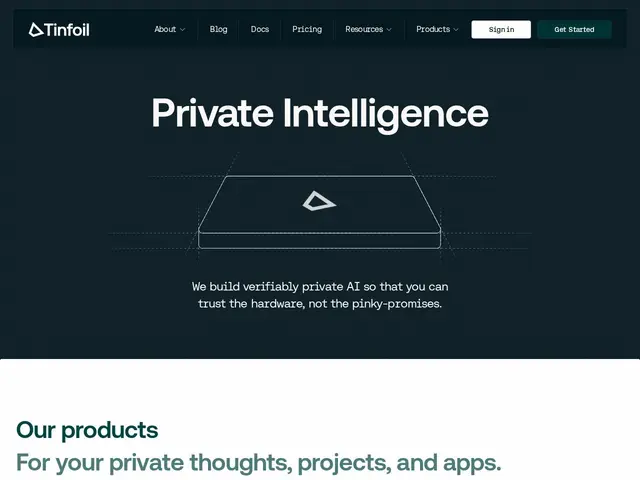
Description
When you use a typical AI chatbot or API, you're trusting the company behind it not to look at your conversations or misuse your data — a promise with no way to verify it's actually being kept. Tinfoil replaces that promise with hardware proof: your data is processed inside a sealed, encrypted enclave that even Tinfoil's own staff can't see into, and you can cryptographically verify that seal yourself before sending anything.
Tinfoil is an open-source confidential computing platform for AI, using hardware-based trusted execution environments (AMD SEV-SNP or Intel TDX, paired with confidential-computing-capable NVIDIA GPUs) to isolate AI workloads from the host system, the cloud provider, and Tinfoil itself. Every request comes with client-side verification tools so the privacy claim isn't just marketing — it's checkable. It offers a Private Chat product (web search, multi-device access, document upload) and a Private Inference API that's a drop-in, OpenAI-compatible replacement for teams that want the same integration pattern with hardware-backed privacy instead. It's a member of the Confidential Computing Consortium and is, notably, the only platform currently offering multi-GPU confidential computing.
💬 Our review
The short version: if you or your organization handle genuinely sensitive data (health records, legal documents, proprietary business data) and want to use AI without sending that data to a black box, Tinfoil's hardware-verifiable privacy is a real, technical answer rather than a policy promise — worth taking seriously if privacy is a hard requirement, not a nice-to-have.
Most AI providers, including the major labs, offer privacy policies and enterprise data-handling agreements, but none offer the same level of cryptographic, hardware-enforced verification that Tinfoil does — that's a genuinely different category of guarantee, not just better marketing. The trade-off is that confidential computing has real performance and cost overhead, and at $20/month plus usage for the API, it's not the cheapest way to access AI models if privacy isn't a specific requirement for you. For a healthcare, legal, or finance team that legally or contractually can't send data to a standard AI provider, this is a meaningfully different option; for a casual user who just wants a cheap chatbot, standard providers remain simpler and often cheaper.
💰 Pricing
📊 Global score
🤖 AI-enriched data
Private Chat : $20/mois (3M tokens/heure, fair use). Private Inference API : facturation à l'usage. Containers : $20/mois + usage. Enterprise : sur devis.
Pros
Confidentialité vérifiable par le matériel, pas juste une politique
Vérification cryptographique côté client
API compatible OpenAI, intégration facile
Seule plateforme offrant du confidential computing multi-GPU
Cons
Coût et overhead de performance du confidential computing
Pas la solution la moins chère si la confidentialité n'est pas un vrai besoin
Écosystème plus jeune que les fournisseurs IA établis