OpenSRE
An AI assistant for the 3am "something's broken" moment — it automatically digs through your logs, metrics, and past incidents to figure out what's actually wrong, instead of an engineer manually piecing it together across a dozen tools.
🔗 Visit OpenSRE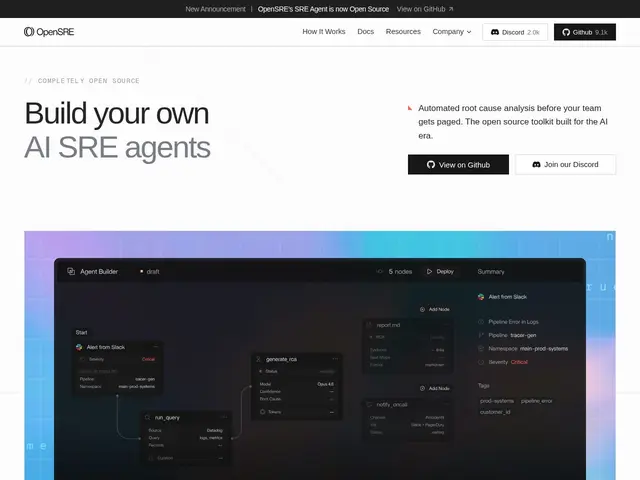
Description
When something breaks in production, the hardest part usually isn't fixing it — it's figuring out what actually happened, which means pulling up logs in one tool, metrics in another, checking recent deployments, and searching old incident notes, all under pressure. OpenSRE tries to automate that investigation: point it at your existing tools, and it correlates the evidence itself to propose a root cause.
OpenSRE is an open-source framework for building AI-powered Site Reliability Engineering (SRE) agents that connect to 60+ tools you likely already run — AWS, Kubernetes, Datadog, Grafana, PagerDuty, Slack — and let you define your own investigation workflows. It correlates logs, metrics, traces, and deployment history to perform structured root-cause analysis during an incident, rather than leaving an engineer to manually cross-reference dashboards. The project is entirely free and open source, currently in public alpha, maintained by Tracer-Cloud with an active Discord community and comprehensive deployment documentation.
💬 Our review
The short version: if your team's incident response involves an engineer frantically tab-switching between five monitoring tools trying to reconstruct what happened, OpenSRE tries to automate that correlation work — and unlike most "AI SRE" offerings, it's completely free and open source.
Its real edge against commercial AIOps platforms like Datadog's Bits AI or PagerDuty's AIOps features is cost and openness: those are add-ons bundled into an existing paid subscription with a specific vendor, while OpenSRE is a standalone, self-hostable framework you can point at whatever mix of tools you already use, without being locked into one observability vendor's ecosystem. The catch is that it's public alpha — meaning real but still maturing, with the rough edges and occasional instability that implies, and getting real value out of it requires actually configuring investigation workflows across your specific stack rather than flipping a switch. Good fit for infra/SRE teams comfortable running an open-source tool in alpha and willing to invest setup time; teams that want a polished, vendor-supported solution with guaranteed uptime should look at a mature paid platform instead, at least until OpenSRE matures past alpha.
📊 Global score
🤖 AI-enriched data
100% gratuit et open source, hébergé sur GitHub, statut alpha publique
Pros
100% gratuit et open source, pas de dépendance à un vendeur d'observabilité unique
Se connecte à 60+ outils déjà en place (AWS, Kubernetes, Datadog, Grafana, PagerDuty, Slack)
Corrèle logs, métriques, traces et déploiements automatiquement
Communauté Discord active et documentation de déploiement complète
Cons
Statut alpha publique — instabilité et évolutions rapides à anticiper
Nécessite un vrai travail de configuration des workflows d'investigation par équipe
Moins de garanties de support qu'une solution commerciale avec SLA
Jeune projet comparé aux plateformes AIOps établies