tweet.md
Turns a messy X/Twitter post or thread into clean, readable text just by swapping "x.com" for "tweet.md" in the URL — handy if you're feeding it to an AI, a note app, or a research doc.
🔗 Visit tweet.md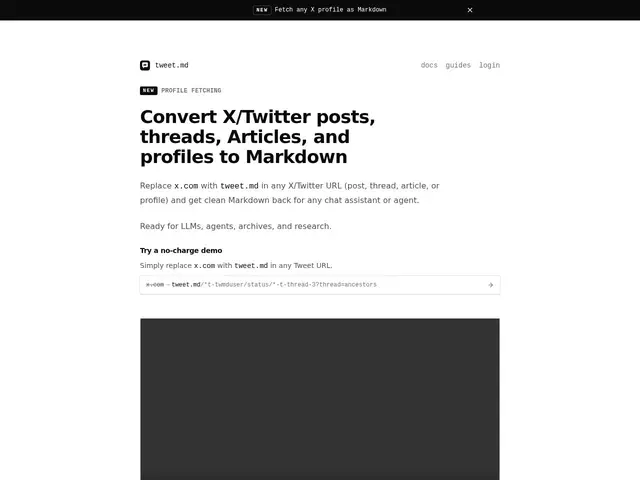
Description
X/Twitter's web pages are built for scrolling in a browser, not for pasting into a document or feeding to an AI model — you get ads, dynamic loading, and a wall of unrelated UI along with the actual content. tweet.md solves that with the simplest possible trick: replace "x.com" with "tweet.md" in any post, thread, or profile URL, and it returns clean, structured Markdown with just the content.
It supports full thread reconstruction with configurable depth, author profile fetching (bio, stats, recent posts), and multiple output formats including plain Markdown and Obsidian-ready files with YAML frontmatter. Access is via a credit-based API with Bearer token authentication and optional IP whitelisting, aimed at developers building AI agents, researchers archiving content, and Notion/Obsidian users who want tweets in their note systems.
💬 Our review
The short version: tweet.md is a small, sharply-focused utility that does one annoying job — cleanly extracting X/Twitter content as Markdown — better than generic web scraping, and it's cheap enough to not think twice about for occasional use.
The realistic alternative is rolling your own scraper against the X API or a general web-scraping tool, both of which involve more setup, more maintenance as X's page structure changes, and (for the official API) meaningfully higher cost for meaningful volume. tweet.md's credit pricing ($5 for 250 posts) is cheap for light use, though it scales linearly with volume rather than offering a flat unlimited tier, so very high-volume archival use could get pricier than a self-hosted scraper over time. For anyone occasionally pulling tweets into research notes, an AI agent's context, or an Obsidian vault, it's a reasonable convenience purchase rather than a strategic dependency.
📊 Global score
🤖 AI-enriched data
Système de crédits : $5 pour 250 crédits, $19 pour 1 100 crédits, $49 pour 3 200 crédits (1 crédit/post + 2 crédits/auteur unique)
Pros
Astuce d'URL ultra simple, zéro configuration
Reconstruction de threads avec profondeur configurable
Formats de sortie multiples (Markdown, Obsidian + YAML)
Moins cher que l'API X officielle pour un usage léger
Cons
Tarification au crédit, pas d'offre illimitée à plat
Coût potentiellement élevé pour un archivage à très gros volume
Dépendant de la structure des pages X, susceptible de casser si X change son site