Timbal AI
A toolkit for building AI "employees" that actually finish a job reliably — instead of a chatbot that just talks, Timbal helps a company wire up an AI agent that can look things up, take real actions in other systems, and behave consistently every time.
🔗 Visit Timbal AI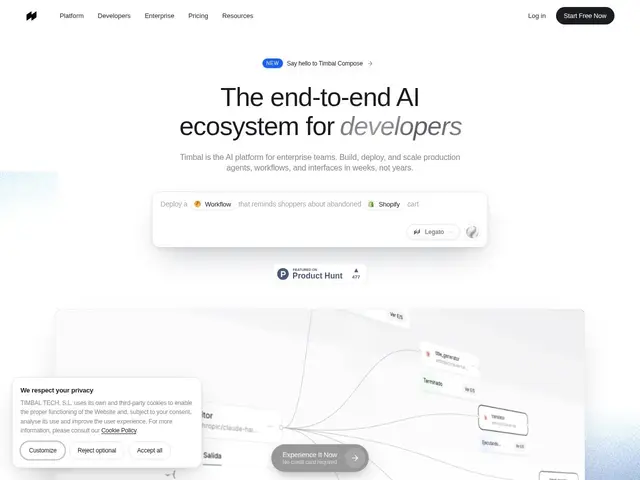
Description
Most people's experience of an AI chatbot is a single conversation window that forgets everything and can't actually do anything outside of talking. Timbal is aimed at the next step up: building an AI system a company can trust to look things up, follow a multi-step process, and act consistently — connecting to real business tools like Salesforce or Slack rather than just answering questions in a bubble.
Timbal is a Barcelona-based platform for building, deploying, and governing production AI agents and workflows, combining a Python framework with a visual "Studio" builder. Its core technical idea is the ACE (Action Control Engine), a runtime meant to keep agent behavior consistent and predictable in production rather than drifting between similar-but-different answers on every run. It ships a hybrid database (vectors + full-text + SQL) for retrieval-augmented generation, 100+ native integrations (SAP, Salesforce, Slack, Microsoft Teams, Stripe, MCP servers), and flexible deployment — cloud, VPC, or fully on-premise — aimed at enterprises that don't want vendor lock-in. Some framework components are open on GitHub (github.com/timbal-ai/timbal), though the hosted platform itself is proprietary.
💬 Our review
The short version: Timbal is built for companies that have moved past chatbot demos and need an AI agent that behaves the same way on the 100th run as it did on the first — the ACE consistency layer and on-premise/VPC deployment options are squarely aimed at that enterprise-trust problem, not at hobbyists.
Compared to more developer-first agent frameworks like LangChain or CrewAI, Timbal packages more of the production-hardening work (behavioral consistency, audit-ready deployment, a visual builder for non-engineers) at the cost of being less flexible if you want to hand-roll something unusual. Compared to a fully open-source alternative like Sim, Timbal is closed-source with only framework components on GitHub, and its pricing — a free individual tier plus paid plans starting around €25/seat/month, with custom enterprise pricing on top — sits solidly in "pay for enterprise reliability" territory rather than "cheap experimentation" territory. Worth it if you're deploying agents that touch real business systems and need governance; overkill if you're still prototyping.
💰 Pricing
📊 Global score
🤖 AI-enriched data
Gratuit pour un usage individuel ; plans payants à partir d'environ 25€/mois/siège pour les équipes ; tarification entreprise sur devis (hébergement souverain, SLA, gros volumes)
Pros
ACE (Action Control Engine) pour un comportement d'agent cohérent en production
100+ intégrations natives (SAP, Salesforce, Slack, Teams, Stripe)
Déploiement flexible : cloud, VPC ou 100% sur site, sans dépendance fournisseur
Base de données hybride (vecteurs + full-text + SQL) intégrée pour le RAG
Cons
Plateforme hébergée propriétaire — seuls des composants du framework sont open source
Le chiffre de '100+ intégrations' n'est pas vérifié de façon indépendante
Tarification entreprise sur devis — difficile à budgétiser à l'avance