Oxlo
AI models on a phone-plan-style flat rate instead of a taxi meter — pay one predictable monthly price for a set number of requests across 40+ AI models, rather than watching a per-token bill climb with every word generated.
🔗 Visit Oxlo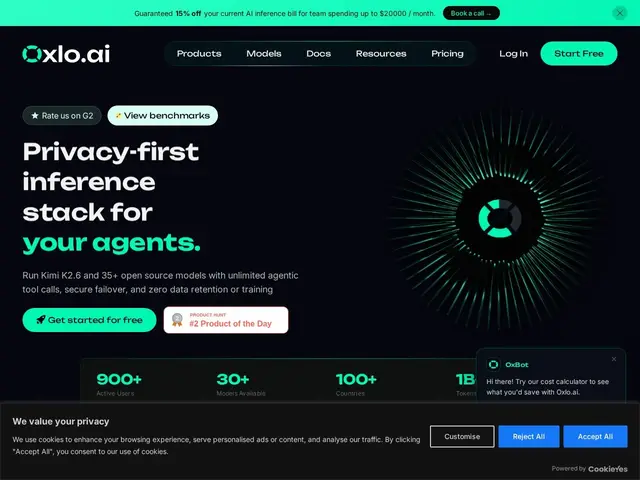
Description
Most AI APIs charge per token, which means your bill is genuinely hard to predict — a chattier user or a longer document can quietly blow up your monthly cost. Oxlo flips that model: instead of counting tokens like a taxi meter, it charges a flat monthly subscription for a set number of requests per day, so the bill is as predictable as a phone plan.
Oxlo is a privacy-first LLM inference API giving access to 40+ open-source and frontier models (DeepSeek, Kimi, GLM, Qwen, Llama, Mistral, and others) through a single OpenAI-compatible endpoint — switching to it is typically a one-line base_url change. It supports multi-modal workloads (text, vision, audio, embeddings, image generation), advertises zero data retention and no training on user inputs, and is backed by parent company Cyborg Network, which the company says has been recognized by STL Partners as a top edge-computing company for 2026. Pricing runs Free (60 requests/day, no card required), Pro at $80/month (1,000 requests/day), Premium at $350/month (5,000 requests/day), and custom Enterprise pricing with a 15% discount guarantee for spend up to $20,000/month.
💬 Our review
The short version: if your AI usage is high-volume and predictable-shaped (a chatbot handling a known daily request count, a batch pipeline), Oxlo's flat-rate model can genuinely beat per-token billing on cost certainty — but if your usage is spiky or low-volume, a request-based cap can waste money you'd have saved paying per token instead.
Compared to going directly to OpenAI or Anthropic, Oxlo's privacy-first stance (zero data retention, no training on inputs) and flat pricing are real differentiators for teams handling sensitive data or budgeting on a fixed AI line item. Compared to another routing-focused gateway like Auriko or Oxlo's request-cap peers, the tradeoff is request-count limits rather than token-count limits — a single very long conversation or document could burn through a day's request allotment faster than expected, so it's worth modeling your actual usage pattern against the tiers before committing to Premium at $350/month.
💰 Pricing
📊 Global score
🤖 AI-enriched data
Free : 0$/mois (60 requêtes/jour, sans CB) ; Pro : 80$/mois (1000 requêtes/jour) ; Premium : 350$/mois (5000 requêtes/jour) ; Enterprise sur devis avec garantie -15% jusqu'à 20 000$/mois de dépense
Pros
Facturation forfaitaire prévisible plutôt qu'au token
40+ modèles open source et frontière via une seule API compatible OpenAI
Zéro rétention de données, aucun entraînement sur les données utilisateur
Compatible en un changement de base_url
Cons
Plafond en nombre de requêtes, pas en tokens — une conversation longue peut épuiser le quota vite
Aucun montant de financement publié, seulement le nom de la société mère
Moins avantageux pour un usage faible volume ou très irrégulier