Rootly
AI-native incident management platform that coordinates the whole outage response in Slack, has an AI assistant that helps find the root cause, and writes the post-incident report for you.
🔗 Visit Rootly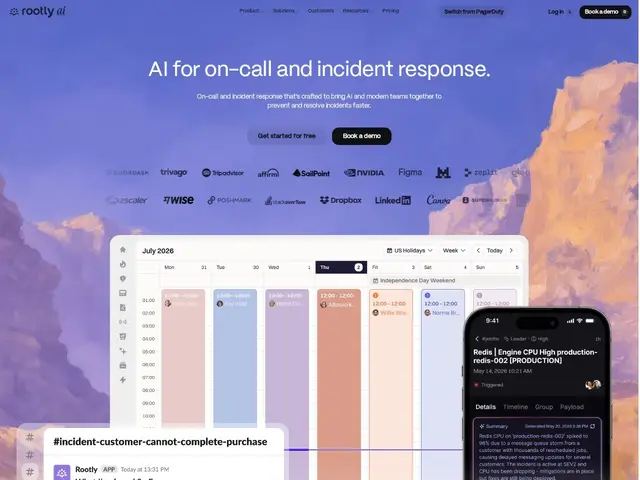
Description
When something breaks in production, an engineering team needs to figure out who's on call, coordinate everyone in one place, work out what actually went wrong, and then write up what happened afterward — all under pressure, often at 3am. Rootly builds that whole workflow into Slack (or Teams) directly, with an AI layer that starts investigating the moment an alert fires and drafts the retrospective report once things are fixed, so the team spends less time on process and more on actually solving the problem.
Rootly covers AI SRE assistance that analyzes code changes, telemetry and past incidents to surface likely root causes, on-call scheduling with a claimed 99.99% reliability, deep Slack/Teams-based incident coordination, automated retrospective generation from smart templates, customer-facing status pages, and 50+ integrations (Jira, Zoom, Terraform). It's positioned as a modern alternative to legacy tools like PagerDuty, with startup-friendly discounts (up to 50% off for smaller, younger companies) alongside enterprise pricing for larger organizations.
💬 Our review
The short version: Rootly's AI SRE feature — starting root-cause investigation the instant an alert fires, using actual code changes and telemetry rather than just pattern-matching on alert text — is a meaningful step beyond traditional incident tools that mostly just route and log alerts without helping figure out what actually broke.
Auto-generating the post-incident retrospective is a genuinely underrated time-saver: writing up a clear, useful incident report after the adrenaline of an outage has worn off is a task engineers reliably deprioritize, and having a solid first draft ready removes a real source of institutional-knowledge loss. Its named customer list (Figma, DoorDash, LinkedIn, Nvidia) spans companies operating at real production scale, a meaningful signal the tool holds up under genuine incident pressure. The honest caveat: Rootly's own claimed "80% reduction in MTTR" and "1/2 the price of PagerDuty with quadruple the capability" are marketing comparisons that deserve independent verification against your own incident history and PagerDuty's actual current pricing/features rather than being taken at face value — a caution that applies to any vendor's head-to-head comparison against a specific competitor by name. Against incident.io (which leans similarly Slack-first and AI-assisted but targets more specifically larger, 100+-engineer organizations), Rootly's startup-friendly discount tiers make it the more accessible entry point for a smaller engineering team just outgrowing a manual on-call process.
💰 Pricing
📊 Global score
🤖 AI-enriched data
Free tier available. Essentials $20/user/mo (Incident Response or On-Call standalone). Enterprise custom. Startup discounts up to 50% for smaller/younger companies.
Pros
AI SRE investigates root cause from code changes and telemetry the moment an alert fires
Auto-generates post-incident retrospectives, a commonly deprioritized task
Named large-scale production customers (Figma, DoorDash, Nvidia)
Startup-friendly discount tiers make it accessible for smaller teams
Cons
Head-to-head marketing comparisons against PagerDuty deserve independent verification
MTTR-reduction figures are vendor-reported, not independently audited
Free tier for the specific features you need should be confirmed before committing