Vertice
AI-powered procurement platform that negotiates and manages SaaS and cloud vendor contracts on a company's behalf, with pricing benchmarks across 32,000+ vendors.
🔗 Visit Vertice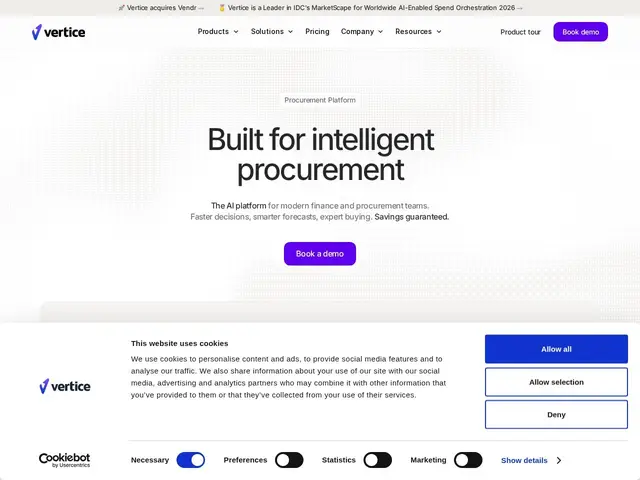
Description
Companies now run on dozens or hundreds of software subscriptions, and almost nobody has visibility into whether they're overpaying for any of them — vendor pricing is opaque on purpose, and negotiating a better renewal rate takes time most finance teams don't have. Vertice takes that job off a company's plate: it tracks every SaaS and cloud contract, tells you what similar companies actually pay for the same tools, and has its own negotiators (backed by AI-driven pricing benchmarks) go get a better deal on renewals.
Vertice combines intake-to-procure workflow automation (routing new software purchase requests through approval, without spreadsheets), a pricing-benchmark database covering 32,000+ vendors, AI agents trained to handle over 70 discrete procurement tasks, and expert-led negotiation on SaaS renewals. It also extends into cloud cost optimization (AWS/Azure/GCP spend visibility and recommendations) alongside its core SaaS-spend focus, aiming to be a single system of record for how a company buys and pays for software.
💬 Our review
The short version: Vertice's pitch is that it pays for itself — it claims a 20% average savings on the software renewals it negotiates, with a 90-day typical payback period, funded by the savings it finds rather than a pure software license fee.
The combination of a large pricing-benchmark dataset (what similar-sized companies actually pay for the same SaaS tools) plus human-led negotiation is the real differentiator over a pure software tool like Zluri or SpendHound — Vertice puts its own negotiators on your renewals rather than just giving you dashboards and reminders. That's valuable if your team doesn't have the time or leverage-data to negotiate well itself, and less valuable if you already have a strong procurement function that just needs better spend visibility, in which case you're paying for a service you don't fully need. The specific savings and ROI numbers (20% average, 7x ROI, $1.1B to $3.4B managed spend growth in a year) are vendor-reported without independent audit methodology — treat them as a starting expectation to validate in your own negotiation, not a guarantee. Against SpendHound (free for smaller companies, paid annual fee above 1,000 employees) and Zluri (now positioned more as identity/access governance than pure spend), Vertice sits as the more full-service, negotiation-included option, generally at a higher overall cost given its outcome-based model layered on top of software.
💰 Pricing
📊 Global score
🤖 AI-enriched data
Quote-based, outcome-focused pricing tied to savings achieved; no public tiers. Claims 20% average savings, 7x average ROI, ~90-day payback.
Pros
32,000+ vendor pricing benchmark database
Human-led negotiation on renewals, not just spend visibility
Extends into cloud (AWS/Azure/GCP) cost optimization, not just SaaS
Well-funded ($101M) with large enterprise customer base
Cons
Outcome-based pricing model is less transparent than a flat subscription
Savings/ROI figures are vendor-reported without independent audit
More costly overall than a self-serve visibility tool if you already negotiate well