SpendHound
Free-for-SMBs SaaS spend management platform with pricing benchmarks from 1,300+ companies, renewal tracking, and contract/invoice management.
🔗 Visit SpendHound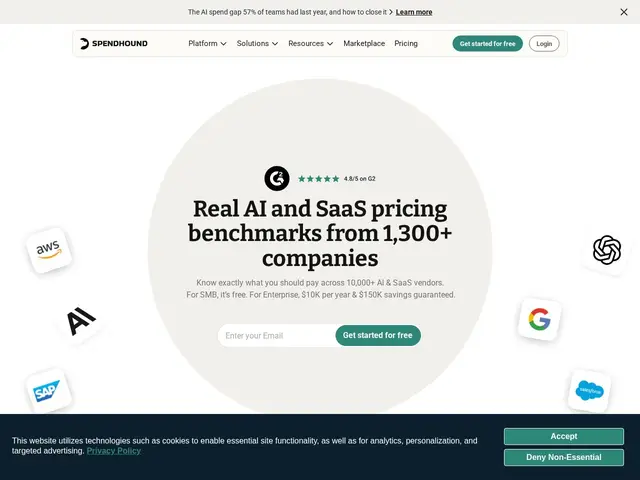
Description
Nobody tells you what your SaaS bill "should" cost — vendors negotiate every deal privately, so a small company has no way of knowing if it's paying a fair price or getting quietly overcharged. SpendHound solves this by pooling anonymized spend data from over a thousand companies: you can see what similar-sized businesses actually pay for the same software, and get reminded before a contract auto-renews at a price you never agreed to compare.
SpendHound benchmarks pricing against 10,000+ SaaS and AI vendors using contributed data from 1,300+ companies, tracks renewals with 30/60/90-day alerts, centralizes contracts and invoices, monitors application usage via SSO integration, and offers expert negotiation support over Slack. It's free for companies under 1,000 employees who contribute their own spend data to the benchmark pool, with a flat $10,000/year enterprise tier above that headcount — an unusually generous free tier compared to most spend-management competitors.
💬 Our review
The short version: SpendHound's free tier for companies under 1,000 employees is the standout feature in this category — most competitors (Vertice, Zluri) are enterprise-sales-only from day one, while SpendHound gets small and mid-size teams real benchmarking data at no cost, in exchange for contributing their own anonymized spend numbers.
The pricing-benchmark database (1,300+ contributing companies, 10,000+ vendors) is the actual value here, and giving it away free to SMBs is a smart wedge — a small team can see instantly whether it's overpaying for a tool without any sales conversation. The renewal alerts and contract/invoice centralization are useful but not differentiated versus Vertice, Zluri or Zylo, which all do something similar. The honest trade-off versus Vertice: SpendHound gives you the data and reminders, but the actual negotiation is described as "expert support via Slack" rather than Vertice's dedicated negotiators handling renewals end-to-end — so if you want the negotiation done for you rather than assisted, budget for Vertice instead once you're past the free tier's headcount ceiling. The specific savings figures ($150,000 guaranteed savings, 30% spend reduction) are presented without disclosed methodology or baseline and should be treated as marketing claims to validate for your own situation, same as any vendor in this space.
💰 Pricing
📊 Global score
🤖 AI-enriched data
Free for companies under 1,000 employees (contributing spend data to the benchmark pool). Enterprise tier $10,000/year for 1,000+ employees, with a $150,000 savings-or-money-back guarantee.
Pros
Genuinely free tier for companies under 1,000 employees
Pricing benchmark pool from 1,300+ contributing companies
Fast integration (~8 minutes claimed) via SSO/ERP connections
Renewal alerts plus centralized contract/invoice management
Cons
Negotiation is "expert support," not full done-for-you negotiation like Vertice
Savings guarantee figures lack disclosed methodology
Free tier requires contributing your own spend data to the shared pool