Morph
API that instantly merges AI-generated code edits into your actual files, so coding agents can make changes without rewriting whole files.
🔗 Visit Morph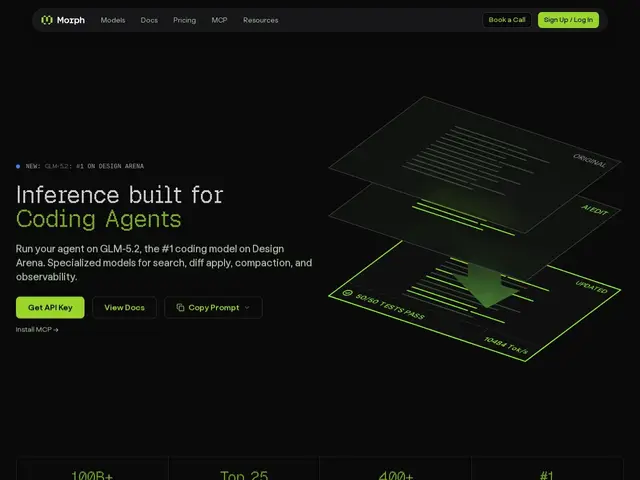
Description
When an AI coding assistant suggests a change, it usually describes the edit in words or a diff — but something still has to take that description and correctly apply it to your real file, matching up the right lines without breaking the rest of the code. Doing that with a big, slow general-purpose AI model is overkill and often unreliable. Morph built a small, specialized model whose only job is applying code edits, fast and accurately, so coding agents can act instead of just suggesting.
Morph's flagship product, Fast Apply, is a 7-billion-parameter model that merges AI-generated code edits into existing files at roughly 10,500 tokens per second with around 98% accuracy, priced at $0.80 per million input tokens. It's available as an MCP tool that plugs directly into Claude Code, Cursor and other MCP-compatible coding environments, and is used in production by companies including JetBrains, Vercel and Webflow. Beyond Fast Apply, Morph offers a small suite of related infrastructure for coding agents: WarpGrep for agentic codebase search, FlashCompact for context compaction at 25,000+ tokens/second, and Reflexes for agent behavioral observability. Pricing includes a free tier (200 requests/month, 250,000 credits worth about $2.50), with usage-based pricing beyond that scaling across all four products.
💬 Our review
The short version: Morph is a narrow, well-executed bet on a real bottleneck — applying AI-generated edits to real files reliably and fast — and being adopted in production by JetBrains, Vercel and Webflow is a solid signal that the accuracy claims hold up outside a demo.
The alternative most teams default to is just asking a general-purpose LLM (GPT-4, Claude, or whatever the agent already uses) to apply its own diff directly, or relying on an agent framework's built-in apply logic the way Aider does — both work, but a large general model spending tokens and latency on mechanical file-patching is genuinely wasteful compared to a small model built for exactly that one task at 10,500 tokens/second. The honest trade-off is that Morph adds another vendor and API call to a coding agent's pipeline, and $0.80/M tokens is a real cost on top of whatever the main reasoning model already costs — worth it specifically if edit-application speed or reliability is a measurable bottleneck in your agent, less necessary if your current setup already applies diffs accurately enough.
💰 Pricing
📊 Global score
🤖 AI-enriched data
Free: 200 requests/month, 250K credits (~$2.50). Fast Apply: $0.80/1M input tokens. Usage-based across WarpGrep, FlashCompact, Reflexes.
Pros
Purpose-built small model (7B) beats general LLMs on edit-application speed and cost
10,500 tokens/second with ~98% accuracy, backed by production adoption (JetBrains, Vercel, Webflow)
Drops in as an MCP tool for Claude Code, Cursor and other MCP-compatible agents
Cons
Adds another vendor and API call/cost on top of the agent's main reasoning model
Narrow scope — solves edit-application specifically, not general coding assistance
Free tier (200 requests/month) is only enough for light testing, not real agent workloads